Y Marks the Spot: I’m Lying. Honest.

There was something I recently read that depressed the shit out of me.  I found this treasure of doublespeak in the customer service section (go figure) of the Burger World supervisor study guide which I am currently ignoring in my inertia toward the illusion of power.  It made me want to ram my head through a wall.

The line is exact, (with the exception of the fact that only Beavis and Butt-head work at Burger World): “The person working the register should always greet the customer in a non mechanical greeting, such as ‘Hi, welcome to Burger World’”.

Do you see how a reasonably sentient creature such as myself might have a problem with this?  The statement red-handedly contradicts itself.  It advocates individuality, so long as it’s the company’s individuality.  It tells you to use your own words and then feeds you an acceptable line.  The line encourages acting mechanical; it just expects you to be good at faking enthusiasm.  Like a stripper.

I get that a person unfortunate enough to have a job involving customer service is like a housewife with a thousand different husbands, living in terror that any one of them will stumble home drunk and beat the shit out of her and then she’ll be blamed by the neighborhood for being a bitch who doesn’t listen.  I hate that thought, as well as the thought that the rules of customer service are written by assholes who don’t have to live with them.  But I think there’s a greater problem suggested by that logic-raping symptom statement, and that is that maybe people don’t really want honesty.  Maybe we’d rather be comfortable.  If that squares with the truth, so much the better.  If not, comfort is the trump.

You don’t see many people telling the rampaging idiots in their lives what they really think of them, do you?  I don’t do it.  I’m too polite, which translates into realspeak as cowardly.

I’ve most noticed my own lapse between ideals and action in friendship and romance, in which “tell me the truth” quickly devolves into “you son of a bitch.”  (The Burger World words of wisdom were referenced in one of my most recent mutual explosions.)  I’m usually a pretty blunt person when I’m visible (for the idiots, I vanish), and my growing disillusionment with the sacred power of truth hasn’t turned me into a pathological liar.  (If anything, I’ll be an in the moment hypocrite, the truth of now contradicting all my prior in the moment convictions.  I’m completely fine with this.)  But I have learned to tell when a person doesn’t really want the truth one howls for, and so with silence and misdirection I’ll sometimes keep that person safe.  I’ve gotten somewhat good at this.

There’s another example in my current life that further illustrates my skepticism of truth.  Once again, it involves my wonderful work.  While it’s a better job than McDonald’s or my late, lamented Old Country Buffet, Burger World is a world in perpetual crisis, and as all the smoke blown up my ass has led me to believe, only I can save the day.  What I’m saying, in so many words, is that I get called in a lot.

In the past I’ve compared my time at Burger World to my best friend’s misadventures within a creepy Christian youth group he went to in order to hook up with a devout teenage girl whom we both liked.  As he told it, the congregation got in full recruitment mode whenever he’d arrive, staring at him in unison and praying for his immortal soul in the hope that he’d join their team and reinforce their existences.  (Thankfully, he got over the girl and married a well-adjusted brainiac whom we both liked.)  Now I feel like I’m in the youth group, and the further up the ladder I’m lured, the further into the trap I go.

It’s been an absolute bitch to beat back my clutching, disastrous source of income into its proper place in my life.  My job is a stupid, tentacled beast that doesn’t think twice about scheduling me six days a week and then trying to call me in on my day off.  It doesn’t blink when it tries to tack on an additional four hours to my shift for no good reason.  It could care less that it’s only one of many things I do, including this and including the occasional day off to relax like a normal person.  And working ten hours on Labor Day was also fun.

But how to tell such a stupid creature, when it grasps for the miles beyond its given inches, the selfish truth?  You can’t.  It’ll just cry until you give in to shut it up.  So I lie, just a little bit.  Inflate the truth.  Make myself seem a hair busier than I actually am.  Just like I did yesterday, a day off the creature tried to steal back with emergencies and sweet nothings whispered into my voicemail (I’ve long since learned to silence my phone on days off).  I didn’t answer, sending a noncommittal text to my boss saying that I had to get my newspaper work done and that it would take all evening.  It only took a few hours, but you can’t give the creature any leeway at all, not if you want your own life.  And I do.

Deceit is a tool, just like any other tool.  Just like truth.  All that matters is how, and why, you use it.

Y Spy: Meklit Hadero

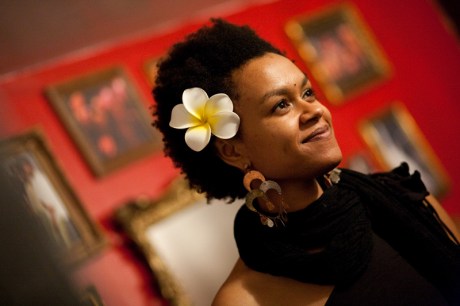
Meklit Hadero sounds like a lot of things: a full-throated jazz pixie, a guitar folk whisperer, a cool and self-collected slinger of R&B.  One thing she never sounds is boring, and I’d also throw in complacent into that mess of things Hadero is not.  A lifelong traveler, the Ethiopian-born singer has collected a vast swath of styles, mixing them together into “On a Day like This,” an album released last year in which Hadero sings of setting roots in San Francisco.

            But in talking with Meklit Hadero, one gets the strong impression that her musical ambitions – goals which are blatantly larger than sound – don’t begin and end with the recording of songs.  Having formed an artistic group of fellow Ethiopians known as the Arba Minch Collective, Hadero has explored and challenged her roots with an intensity that is hard to match.


Y Spy:  Let’s start with the basics.  Who are you, and what is your musical background?


Meklit Hadero:  I’m a vocalist and a songwriter originally from Ethiopia.  I was born there and grew up all over the States: in Brooklyn and in Florida and in Seattle.  I’ve been in San Francisco the past seven years.  The music kind of sits at the crossroads of three different traditions: the American songwriters, jazz, as well as bringing in some Ethiopian music and influence.  I primarily play with jazz instruments, plus I bring a lot of improvisation into the live shows.


Y Spy:  How has traveling around internationally as well as within the United States affected your musical perspective?


Hadero:  When people ask me what my influences are, I tend to think less about who are the artists that I model myself after and more about what the sounds are that I’ve absorbed growing up.  For example, living in Brooklyn for six years, the place I grew up in my childhood years, jazz was everywhere.  It was in the subways and in the streets.  So was early hip-hop.  That sort of soundscape, the streetscape, of New York felt like it was an important sonic ingredient.  Then, of course, growing up and having my parents play old Ethiopian cassettes.

There was a constancy of sound as a presence in one’s life, and how those sounds then get interpreted as songs, and where they come out, is something of a mystery.  But it does happen, and that was a big part of how I developed this particular approach to making music.

In terms of influences, though, I’d say that my biggest influences have been my voice teachers, people who taught me what the voice is and what its expressive power as an instrument is.


Y Spy:  How did you put together On a Day like This?


Hadero:  I wanted to make it as a tribute to my first five years in San Francisco, because at the time I wasn’t sure I was going to stay.  I had just done a residency at the De Young Museum and was about to go to Oxford for a few weeks to do the TED Global Fellowship, and then I was going to travel for three months.  I called it my cliff; I had no idea what was going to happen after this particular period of time.

It was just about two months before I left when I said: I have to make an album before I leave.  I realized that I wanted to capture the period of time that had happened.  So it was really about who I had been playing with for those five years of developing those songs, bringing together all these jazz musicians who I had played with and who were a big part of my musical community, but also bringing together a lot of musicians from a collective of classical artists called Classical Revolution that are all about changing the way classical is played, making it more accessible.  They have chapters in ten or twelve cities, but they started in San Francisco a few blocks from my creative home at the Red Poppy Art House.  That’s how I brought people together.


Y Spy:  As you’ve said, On a Day like This mixes together a lot of styles.  Was it difficult, considering this, to constrain all of these different directions to something as finite as an album?


Hadero:  I have real faith in multiplicity.  I feel like people have a lot of capacity for bringing together complexity than is offered in a lot of marketing.  Nobody’s really one genre.  It’s really hard to label anyone’s music.  The best descriptions of music are poetic.

I never thought of it as limiting; I thought of it as a window.


Y Spy:  Were there any styles that you do wish you had explored more on this album, or that you would like to explore more on a future release?


Hadero:  I have a few releases coming out.  I’m actually in the middle of two albums right now.  Gabriel Teodros is a Seattle-based MC who, with Burntface and I, went to Ethiopia in May as part of this collective that travels there annually to connect with artists, traditional and contemporary.  We just finished recording an album which we call our Ethiopian hip-hop space opera.  So I’m working with two MCs, and it’s all with beats, and in it Gabriel is a half-alien, half-human coming to Earth for the first time.  It’s a really theatrical, big production, and that will be out in January.

Also in January is a simultaneous release with an Oakland-based soul singer called Quinn Deveaux.  We’re doing soul interpretations of indie rock and art rock songs, with a few originals on there too.  Some David Byrne and Patti Smith, but really bringing the soul roots of that music to light through this collaboration.

I’ll continue to make the music that is interesting and inspiring to me, but I really don’t feel limited by style.  Collaboration lets you grow in that way.


Y Spy:  It seemed that in the old top-down musical model, musicians would release work every two years or so, but there wasn’t a whole lot of recording or outside activity inbetween.  Do you feel like people are becoming more open to collaboration now, being that the terms aren’t so dictated from the top?


Hadero:  That’s exactly what it is: the terms aren’t dictated from the top.  We’re also in a place where nobody knows what works, so there are no rules.  You might get pressures from all sorts of sides to be more defined and hyper-focused in your scope, but now nobody knows.  So try something!

Part of what makes me empowered is my relationship with Porto Franco Records, the label I work with.  They’re based in San Francisco, a father-son team, and they are ridiculously supportive.  They’ve helped me make these records, and they really believe in their artists – and I think they believe in artists in general.  That’s been a relationship that has made a lot of this possible.


Y Spy:  What do your recent touring plans look like?


Hadero:  As I mentioned, we were in Ethiopia and Kenya in May.  I’ve been doing some summer touring; this particular tour starts in the Bay Area and winds all the way up the West Coast.  I’m doing an East Coast tour in October, hopefully heading to Europe in November.  But right now, aside from these short tours, I’m trying to finish up these albums and gear up for January.  2012 is going to be really tour intensive.


Y Spy:  How did you go about gathering fellow Ethiopian musicians to form the Arba Minch Collective?  Were these people you already knew or people you sought out?


Hadero:  Kind of both.  There was a website called habesha.com that came out in 2001.  It started as a website to bring together Ethiopian-American and Eritrean-American artists.  It was at the height of the tensions between Ethiopia and Eritrea.  What they ended up doing was bringing together and finding Ethiopian-Americans, Ethiopian-Canadians, Eritreans, and artists in diaspora.  They started writing about them, they started compiling lists, and suddenly there was a place where you could find out what all these people were doing all over the world.  It kind of underlined this emerging generation.  On Myspace you started finding out about people, and then there started being conferences where people would get together.

This network of artists who were doing work that I really loved, that I had been paying attention to for quite a while, I started meeting them when I started performing a lot.  There was an awareness, you would say.  What happened was that I found out about something called the 1,000 Stars Festival that brought together 56 ethnic groups from the south of Ethiopia to play their music together.  They’re distinct ethnic groups with different cultures, different music, different food even, and they came together in this festival and danced and sang for three days, for 50,000 people from Ethiopia.  I thought: I had to go, but how much more powerful would it be if it wasn’t just me that goes, but a whole generation that’s in this process of defining itself and could really benefit and learn from going to this?  So the group started for a particular experience.  The festival was cancelled, and we went anyway and had an amazing time traveling throughout the country and connecting with a burgeoning artistic movement.  Our first trip was in December 2009, and our second trip was this past May, and we will continue to make annual trips.


Y Spy:  In America, culture seems relatively formless and changing, taking connections for granted.  What is the importance to you of having these connections with artists from your homeland?


Hadero:  In a way, it’s about reality.  What I realized is that, growing up in the States, my whole experience of Ethiopian culture was filtered through my family lens.  There were the stories that I would hear, experiences that particular people would have, but that’s such a small part of this grand picture of culture.  What I realized is that things are changing there, fast.  They’re changing extremely fast.  Every time I go to Ethiopia, it looks different.  Infrastructure is growing so fast, and I think it’s also in a process where there are huge pressures happening, too.  If I really wanted to understand what was happening, I couldn’t rely on these filters.  I’d have to go, but I had to go again, and again, and again, in order to have an accurate picture.  If I ask myself why, my tendency is to answer with almost intuition – because I have to know, because I have to learn.


Y Spy:  How does that compare with the artistic connections and your perspectives about and with America?


Hadero:  I read in the New York Times, ten years ago, that 70 percent of New Yorkers are foreign born.  That blew my mind!  For me growing up there, that was the norm.  Diaspora was the norm.  I know it’s not like that all over, and borders are real, and contested, and challenging.  But we also live in a place of multiplicity, and we can’t deny that.  That’s what the world is like, and if we want to prepare ourselves for interacting with the whole world, we kind of have to be a little bit curious.  And music reflects your times.


Meklit Hadero will play the EMP Level 3 Stage at Seattle’s Bumbershoot Festival at 9 pm on Saturday, September 3rd.  Her album, “On a Day like This,” is available now.

Y Marks the Spot: The Big, Terrible Silence

A whole lot of awesome nothing.

I don’t adapt quickly, but I do adapt brilliantly.  I act with the speed of an ice age.  My process of learning involves a lot of trial and error, a lot of intellectual probing and catastrophic screwing up before I figure out the scheme, and then, poof, I’m a half-assed expert.  I come into the game with everyone around me convinced that I’m the dumbest creature to ever evolve thumbs, but when I’ve hit my stride I suddenly become a sullen, sarcastic, shambling shade of gold.

So it’s not surprising to me that, one month to the day since I traded in extreme social claustrophobia for wonderful, titanic freedom, I still haven’t adjusted.

The night that I moved into my new place and joined Clarence Clemons’ band, I was too overwhelmed to think.  I paced around the planks of my big, beautiful, empty rooms, amazed that things had worked out so wonderfully.  But I couldn’t sit down.  I couldn’t stop thinking about things I wanted to get for the place and how I wanted to arrange the furniture.  The past year of living in paranoia without any sort of permanent, sealable sanctuary had wound me up to the point where, once a place of silence finally swooped in and presented itself, I reacted with something resembling horror, becoming a poster boy for antisocial shell shock.

The plan on that first night was that my girlfriend and I would eat pizza and get drunk on screwdrivers – a luxury that I now, in all my total heavenly glory, can once more afford.  Only the food happened, and then we sat, both stunned by the new, scary quiet.  Sleep – another luxury that I can once again afford – happened, eventually, but we did not ride in triumph to it like Wagnerian Valkyries.  Instead, we slithered into it like sluggish mud men.  Anticipation, as usual, disappointed.

A month later, I still feel like I’m living in a state of shock.  The big spaces are being filled out; the place feels less like a void and more like a nouveau riche dwelling of some insipid Ikea socialite or Wal-Martian dignitary.  I live like a normal person.  I have the den I’ve always wanted, my folding card table desk and lawn chair recliner ready to accommodate my every bargain basement philosopher-king whim.  Yet I feel like I’m still waiting for some big fireworks display to happen before I crank the bolt off the fire hydrant in my brain and let the brain-kids dance around in its street corner flood.  There’s still terror, and indecision, and intimidation, and solitary agoraphobia.  I’m still waiting, and the time for waiting has passed.

In the meantime, I’ve been junkie-devouring all the meager distractions that I’ve brought into this Spartan villa.  There’s no more cable TV.  No internet.  No friends.  We watch cartoons on my girlfriend’s computer and, on a future day when we’re not too burned out from and/or pissed off about our respective jobs, we have a mountain of board games to fulfill our senses of communal distraction.  But, in the meantime, I’ve used some of my new disposable income to acquire and consume – in my usual hyper-obsessive style – a few video games for my portable systems.  They’re games consciously chosen, instead of like back when I used to have one night stands with any random stimuli with 16 bits and a boner, but it still adds up to time that could be better spent.  It still adds up to more waiting.

Yet I also feel like there are cracks in the old wall.  Evidence?  Well, this, kind of.  In my last place, and even back when I lived alone in La Crosse’s Stately Y Manor, I’d get so freaked out – in my usual hyper-obsessive style – over the minutiae of every sentence of even the most inconsequential things I’d ever written that it would take me a day to creak out something that could have taken an hour’s time.  Which is how long this has taken, thus far.  Thanks, improv.

But this column is something structured, something needed from me, requested from an external source, an editor needing material to fill a newspaper.  The true test of success in my new, voided ecosystem is whether I start writing things unasked for, works that nobody but me has any vested interest in the completion of.  I have a bizarrely reliable work ethic, despite my tendencies to despise the expectations of others.  I do what’s needed.  The problem is that, for all my narcissism and megalomania, I haven’t yet adapted to the idea that it’s even more important for me to be brilliant when I’m the person who needs something from me.  Instead, my earth-shattering ambitions remain optional.  That is bullshit.  That must change.

We’ll see how that goes.  I did buy a lamp for my den tonight.  Perhaps it will illuminate something.

Y Marks the Spot: The Staged Chaos

I can’t say that in the past year I’ve spent nigh-homeless – sleeping on an air mattress in a flea-ridden house on the verge of collapse, getting rejected for jobs I’m grossly overqualified for, and counting my comatose life by the week instead of by the day – I’ve never considered moving back to La Crosse.  Sure, I would have been really unhappy and felt really defeated, but every so often it felt like defeat, at the very least, would bring a little stability and familiarity.  As much as I find a great deal of fault with it, La Crosse is my home.

Yet there was one point which I reminded myself of every time these regressive thoughts crept into my depressed brain.  It pretty much became the last line of defense that kept me out here in Washington even in my most frustrated lows.

La Crosse doesn’t have improv.  So I can’t go back.

I found improv on the day after I arrived in Bellingham, though it would be a month before its importance to me took shape.  On the second day, my new roommates showed me around my new city’s fantastic downtown, where I wandered around a bit wide-eyed.  We drifted into a small coffee shop, and everyone else in my group ordered things.  Since I don’t drink coffee and don’t care about measly café food, I lingered off near the wall, thumbs in pockets, and I stared at the giant block of fliers upon it.

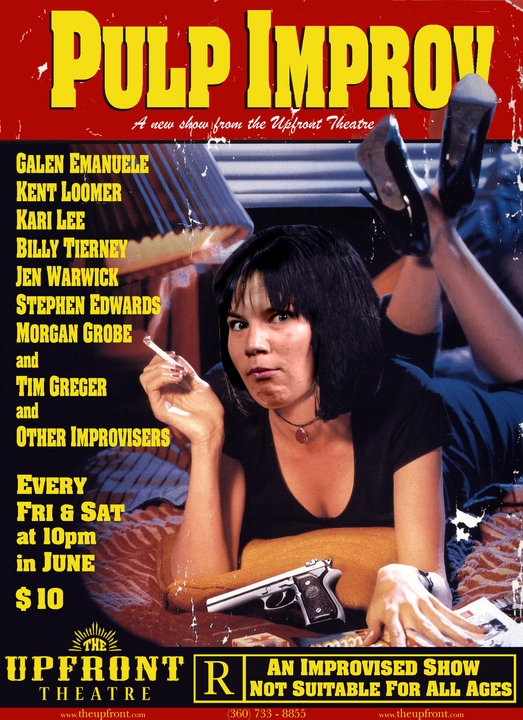
There was one poster which I gravitated toward, a mockery of Pulp Fiction’s cover art in which Uma Thurman’s hip sneer replaced by another girl’s silly smirk.  Clearly the show it was hyping seemed like something that I’d be into (especially if they brought out the Gimp), but as I was still overwhelmed from crossing half the country it flew over my head.  We left the café and wandered across the street to a record store, where I found a Wesley Willis album for sale – a clear and time-honored indication that good things were in store for me.

A few weeks later, the poster and I would again cross paths.  One thing I’ve long wanted to start doing is performing stand-up comedy, but I hadn’t been able to find a consistent open mic in La Crosse to work on it.  One of my goals in coming to Washington was to find a comedy venue and start performing, and a quick Google search in this pursuit brought me to the place advertised by Fake Uma.  This would turn out to be the best Google search I’ve ever done.

Discovering improv at the Upfront Theatre was the same sort of lightning bolt to the brain that happened to me when I started writing these sorts of things and seeing them in print in the Second Supper.  Like, Jesus, I didn’t have my entire life and the rest of the world figured out after college, and there were still plenty of amazing things about myself and said world to find.  I found one such game changer during the Upfront show on the Thursday before my improv education began.  The hour and a half of people on stage, just making shit up, was both hilarious and a serious revelation.

I’ve described the way I felt watching that show the same way to a few people, and a year into improv hasn’t dulled the feeling at all.  It felt as though I had found my tribe.

I’m big into chaos and goofing off and making things and the eastern religion stripes of nihilism, and improv satisfies all of these sensibilities.  It’s something that I both knew from the start I’d be great at, and it’s a process which has made me get over myself and work really hard to get better.  Improv has made me proud of failure.  It makes me less paranoid and insular and frustrated.  It makes me a far better writer (when I stop being lazy or depressed and actually write).  It taught me to get over my own agendas.  It has made me far more brilliant.

Improv has been the one consistently good thing I’ve had going in the past year.  Sometimes, it was the only good thing.

After a year of classes, I now perform about once every other week in the Upfront’s student portion of its Thursday shows.  A group of six of us will go out, get about a half hour of time, and go berserk making shit up.  Sometimes we screw up, sometimes we’ll say horrible things that derail the scenes, but mostly we destroy the crowd.  After just about every show I leave feeling as though I’ve helped to accomplish something amazing.  I feel like an architect who makes skyscrapers out of the sky.

This is something I want to keep doing.  I don’t care how, or where, or with whom.  The Staged Chaos is in my blood and in my future, and that alone has made my adventure worth it.

Y Marks the Spot: What’s Old Is Crue Again

Not the danger I was looking for.

The message, forwarded to me by Captain Adam Bissen of the USS Second Supper, contained the typical chummy form letter used by music publicists since music publicists emerged from the oceans.  Hey, super-cool people of [insert publication], just wanted to let you know about [insert band], who are coming through [insert town] on [insert date].  Would you be cool with inserting a little publicity for the show into your fine publication?  We can set up an interview if you’re interested.  You rawk!

The only difference between this message and every other one I’ve received since I emerged from the music journalism oceans was that [insert band] was Motley Crue.

“You interested?” Bissen asked.  Shit yes, says I.

Yet what would probably have been the biggest music interview of my phony career in music journalism was not to be.  As it turns out, I don’t feel that bad about missing out.

The next message I received from Captain Bissen cast doubt upon the interview’s likelihood.  It included another forwarded message, this one a response from Admiral Roger Bartel of the USS Second Supper to Motley Crue’s publicist.  I’m pretty sure Roger wasn’t using a form letter.

The summary of it is that while there are a lot of local venues and businesses that support the Second Supper, Fort McCoy has not been one of them, so there’s not much reason for the Supper to promote its shows.  After giving a shoutout to more symbiotic venues like Freedom Fest, the Kickapoo County Fair, and the Eau Claire Jazz Festival, he closes with this awesome line: “for some reason Fort McCoy is not interested in reaching audiences under 50, which is exactly our audience. Sorry we can’t be of more help.”

Shit yes, says I.

Here’s something I’ve felt for years which may not make me popular among certain people of my hometown: I don’t think that most people in La Crosse give a shit about anything that isn’t safe, simple, and right in front of them.  La Crosse has no sense of creative community beyond a few freaks who all get ignored because beer is cheaper and more readily procured.  Major bands play major shows at the Warehouse all the time and the Root Note has thrown together some sweet performances and Jammin’ George is one of the funniest bastards I’ve ever met and I’ve heard word about a bunch of Noise City schmucks sowing discord at the Cavalier and there have been loads of amazing musicians in town scraping by doing shows in the dirtiest corners of bars and basements and Chris Zobin puts bologna on his face and croons about the dangers of shaking babies and La Crosse as a whole simply cannot be bothered to give the slightest subatomic particle of a fuck about any of it.

But Motley Crue?  A band as old as I am?  Golden.  Hordes of my fellow Midwesterners will show up at Fort McCoy, probably ignore any song that isn’t “Dr. Feelgood,” “Kickstart My Heart,” or “Girls, Girls, Girls,” go nuts for those songs, fart, and go home.  La Crosse’s other newspaper will cover the show with its typical bland tripe, and the radio stations will fawn.  Fists will be pumped, heads will be banged, rebellion will be faked, and what I’m assuming will be a fine, high-production show will go off without a hitch or the faintest sense of danger.  I doubt anybody will go home afterwards and write a song.

This void is a big reason why I left La Crosse, and why I don’t ever expect to live there again.

Bissen told me that if I really wanted to, I could pursue the Motley Crue interview, but after reading Roger’s letter (and being really, really proud of it) I lost all interest.  Ultimately, my decision not to go for the interview was based less on giving the finger to La Crosse’s smug and sedate victory lap rock concert scene than it was on my complete disinterest in interviewing a band that has been around since the 80s and has had its dirt splashed across a vast product line of books and VH1 specials.  What the hell am I, or anybody, going to add to the story?  I’m assuming it would end up being the whole prerecorded “this is our best album/tour ever” bullshit hype that makes reading most Q&As with major musicians pointless.

Besides, if you’re a fan of Motley Crue, you don’t really need a prick like me to convince you to go, do you?

So Motley Crue is playing this Friday at Fort McCoy.  You’re welcome, [insert publicist].  The show will probably be pretty good.  Go if you want.  Or don’t.  I don’t give a shit.

Bizarro Masterpiece Theatre: Fubar 2

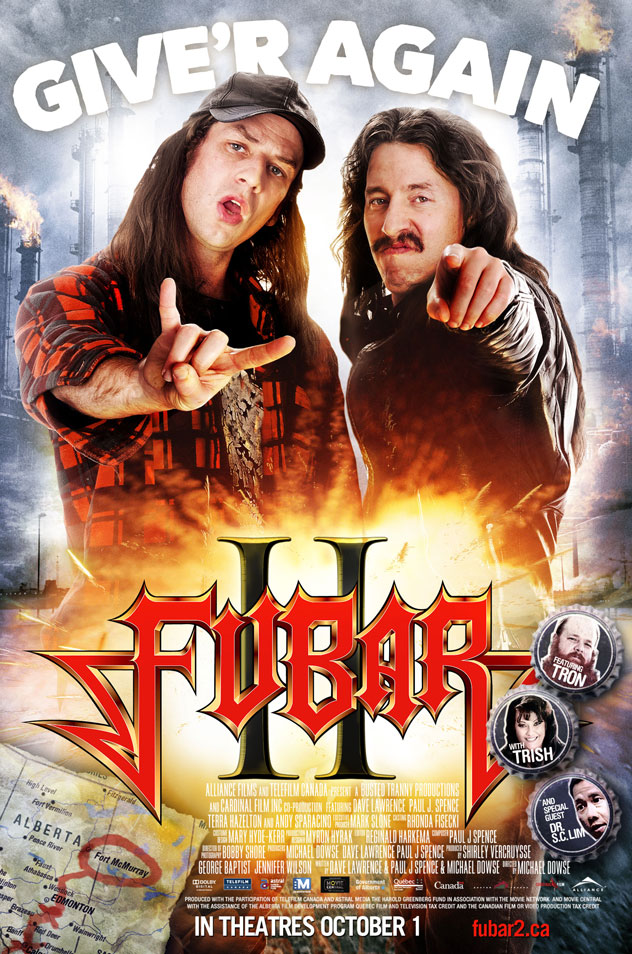
Film: Fubar 2 (2010)

Director: Michael Dowse

Starring: Dave Lawrence, Paul J. Spence, Andy Sparacino

Written by: Dave Lawrence, Paul J. Spence, Michael Dowse


My favorite Canadian hosers of all time are back!  (Sorry, Rowsdower.)  The successor to the great Fubar reunites the world with Terry and Deaner, the Beavis and Butt-head of the Great White North.  Their noble philosophy of partying their asses off and givin’r has not waned in the long years between the first film and the second, though the sequel does lead toward a resolution of sorts.

There is something confusing about this film.  The first Fubar was presented as a faux-documentary in which the filmmaker died after performing the wussiest bellyflop in human history.  I’m not sure if Fubar 2 is meant to be the same breed of Spinal Tap or not.  Occasionally people speak to the camera, and their names are listed on-screen, but more often than not people act as though the camera is not there.  There’s definitely no evidence of a camera crew.  More disturbing, when the dead filmmaker pulls a Jacob Marley and appears before Deaner in a Christmas vision, it’s caught on tape.  So if Fubar 2 is meant to be a documentary, it’s one that has evidence of the afterlife – which may or may not be more important than the misadventures of two rowdy Canucks.

The worst part of Fubar 2 is that Terry sells out for poontang.  Here’s another thing I don’t get about the movie: he starts hooking up with a burly strip club bouncer who quickly becomes a shrieking, gold-digging shrew who screws around on him and gets pregnant with somebody else’s kid, but all of a sudden Christmas comes and she becomes a saint.  There’s no transition in this; one minute she’s a bitch and the next she’s a sweetheart.  Sadly, Terry puts up with it.

The best part of Fubar 2 is Tron, the whipped pal of Terry and Deaner’s from Fubar who flew off the wagon, ditched his bitch, and resumed his responsibilities as a one-man wrecking crew.  He’s kind of a turd when Terry and Deaner come around his work buddies, but by and large the man does not screw around.  The film’s opening scene shows Tron storming onto the scene by running over a tree with his truck, after which he has a rap attack and demolishes Stately Terry and Deaner Manor with a chainsaw.  His slow decline into a drug-fueled depression over the story’s progress only makes him more awesome.  Tron funkin’ rules.

Deaner is as sage as always, dispensing Socratic pearls of wisdom such as “Knowledge of non-knowledge is power.”  He also sings a wicked cover of Boston.

While it doesn’t eclipse the first film, Fubar 2 is pretty goddamn epic.

Y Marks the Spot: Farewell, Tent City

I really, really hate retroactive justification, the self-delusions that state that all the crap you’ve gone through has led to the amazement and satisfaction you currently feel.  To me this “everything happens for a reason” bullshit is little more than rationalizing laziness and/or masochism, and it isn’t much different than pissing away one’s life in waiting for a glorious Rapture.

That said, all of my current problems ended in the span of a single day.  They didn’t end in the best of all possible ways, but the normality that is finally about to return is a very good one.  While I won’t say that this single day’s payoff was worth the previous year’s cost, I once more feel like my life is running with a heightened sense of appropriateness, or at least narrative.

The day was the first day of summer, a good friend’s birthday, and I had no expectations that it would be anything but the usual timeless time wasting that characterized my year of ungainful employment.  I was sleeping in my bedroom tent that once was a dining room when my phone, a new one that recently replaced the old wreck I finally euthanized with a washer ride in garbage-covered jeans, blared out the triumphant theme to the NES game, M.U.L.E.

It was the manager of an upscale fast food joint I halfheartedly applied to and interviewed for weeks before, someone I hadn’t expected to hear from again.  He wanted me to drop by for another interview.  After wiping the crap out of my eyes and putting on some less-wrinkled clothes, I walked into his place and was immediately given a job.  Poof.  Done.  In the blink of an eye, I was once again gainfully employed.

I didn’t really know how to react.

I texted my friend and let her know that my birthday present to her was me getting a job.  I’d have called it a cheap gift if I hadn’t been living below cheap for the past year.  After that I went home and surprised my girlfriend (and tentmate) with the news.  Maybe an hour later, she got a phone call of her own, and we had more surprising news.  Her friends were moving out of their stately apartment, and they were wondering if we wanted to take it.  This Friday, we move in.

All of this happened in one day.

I’ve lived in far worse situations than the one I’m about to leave.  The tiny two bedroom drug den packed with five people, bongwater carpets, and shotguns sitting out in the open comes to mind.  As does the place where people slashed each other for fun, ripped each other off for cheap profit, and attempted suicide from time to time.  The apartment I lived in eight years ago in which people were too busy buying weed and pizza to pay our bills still casts a long shadow over my destroyed credit.

In contrast, the people who live in the house that houses Tent City are upstanding, beer-soaked Wisconsin transplants who (eventually) pay their bills and aren’t unduly dramatic or self-destructive.  It’s bizarre and uncharacteristic that I’ve been the one who hasn’t been able to pull my financial weight and have been dependent on their charity.  I’m excited to come back here and hang out once hanging out become a choice and not an enforced default.

So what follows isn’t about burning bridges.  That said, I cannot wait to get out.

At first, Tent City wasn’t even a tent.  After we cleared out everyone else’s stuff, what was left was a dining room with no walls or doors, indiscriminately letting in light and sound.  After being sent my old curtains and tenting up the place, only the sound remained a problem.

My tentmate and I spent the first four months out here sleeping on a dimpled air mattress which made obnoxious fart noises any time someone moved on it.  The acquisition of the simple, single queen mattress we finally replaced it with was celebrated with alcohol and chocolate cake.

There are rats in the basement of this house, massive gopher holes have ruined its yard, and the trashman eventually stopped collecting our garbage.  Beer bottles breed like rabbits on the furniture.  The television is never off, even if nobody is watching.  If anything was ever cleaned in this house, it was usually due to me or my girlfriend, and we also had to be permanently on guard to make sure our baby cats didn’t get outside from the many ways out of this dilapidated wreck.

But the worst thing about living here has always been the lack of walls.  With all my previous bad situations, no matter how bad things got, I always had a room to retreat to, a place to filter out all the noise and damage.  In Tent City, that safety doesn’t exist.  I hear everything.  It got worse once it started getting cold and everyone started coming inside, worse still once my roommate who was living in the basement got flooded out and moved into the living room next to Tent City.  Some of us have rooms, but none of us really have any space.

Along with the massive sense of paranoia I developed from not having a place of my own, I’ve pretty much abandoned hopes of normal sleep, and for the time being I’ve all but abandoned writing.  Every word written has become a battle held between my brain and every outside noise and distraction, and fighting hasn’t been worth it.  I admitted defeat while plotting my way out, and I saved myself further implosion and frustration.

But that’s about to end.  I’m about to move into a place with no noise and no distraction.  My own safe place.  A place to get things done.  I’m about to become myself again.  I’m about to obtain the potential to become better than I’ve ever been.

Tent City, I’m pulling up your stakes.

Y Marks the Spot: Choke Back

Wisconsin Supreme Court Justice David Prosser, and his bitch-chokin' hand.


I don’t really care who David Prosser is as a person, any more than I have any concern over who any public figure is in real life.  Being that Prosser is a politician affiliated with one of the big two political parties in America, his identity is even less relevant.  I know that America pushes its ideals of individualism to ridiculous heights (see: giving corporations the rights of people), but its citizens are fantastically deluded in thinking that candidates matter.  If there’s a D and an R on the ballot, you’re voting for a party and not a person.

Justice Prosser, recently reelected (in theory) to the Wisconsin Supreme Court, is an R, and he’s jumped right into line with the rest of the Rs who have lost their minds and are dead set on imposing Dark Ages corporate Sharia law upon all us unworthy plebeians.  The Republican Party hates the Taliban for its freedom.

I’m no fan of violence in the workplace, but if Justice Prosser wasn’t one of those hard Rs the recent allegations of him choking his fellow justice would have flown past all of our radars and remained a quiet matter for the authorities to deal with.  As it stands, Prosser is a key part of the Republican Party’s attempt to create a one-party system in Wisconsin, which is a key part of the Republican Party’s attempt to create a one-party system in the United States, and so on.

So I’m going to say something that goes against the spirit of American justice: whether Prosser choked his colleague or not, I hope the allegations ruin his career.  I hope David Prosser becomes the O.J. Simpson of the Wisconsin Supreme Court.  Because as a judge, he’s not a person, but an R, and right now the Rs are the arrogant, entitled, aristocratic, authoritarian enemies of freedom, and their rampage must be stopped.

In one thing, all the right wing hate speech is absolutely correct: at the moment, we’re living in a culture war, and there are only two, individual-less, sides to the conflict.  There are the Republicans, fueled by aristocrats, zealots, and lackeys – and there is everyone else.

Everyone else, this is a fight, so fight to win.

You know who’s doing it right?  Minnesota.  Instead of doing the time-honored Democrat Kowtow, Governor Mark Dayton stuck to his guns, refused to budge on taxing the rich, and let the Republicans shoot their hostage.  And good for him.  Let the Republicans expose themselves as bastards so fixated on giving the rich a free ride that they’re willing to destroy the entire Minnesota government to get their way.  Shit, the national government almost went into the same hole because the Republican Party hates women (see: Planned Parenthood).  Why not defuse the Republican bomb by calling its bluff and blowing it up?  What leverage does shrapnel have?

(Update: Never mind.)

Still, I hate placing my faith in any person in any position of power.  So you know who else is doing it right?  Every person who is still sufficiently pissed off in Wisconsin to keep fighting Scott Walker’s hostile takeover of the state.  It’s goddamn disheartening to see that the Governor is so callous and programmed that the shouting of hundreds of thousands of angry protesters has rolled off his back like oil off a BP duck.  It’s infuriating to see the Wisconsin R continue its unlubed gangbang of the state’s civil liberties and its citizens’ way of life (see: proposed redistricting, concealed carry).  But getting infuriated has led to the people of Wisconsin standing up, getting awesome, and becoming the pinnacle of today’s American Dream.

By the way: hey, James Smith, you fucking scumbag, how’d sabotaging La Crosse’s recall election work out for you?

But here’s the problem: all of us in the way of right wing treads are facing some seriously crooked opposition who will destroy anyone in their way (see: Andrew Breitbart vs. Anthony Weiner).  Against such ruthless assholes, we kind of have to take our victories where we can get them.

So when the swing vote in the Wisconsin Supreme Court goes to a dubiously-elected R who immediately smacks down a good chunk of the protesters’ progress, a well-timed story about said Justice Prosser, as the slang goes, choking a bitch provides great ammo that we’d be fools not to use.

Am I wrong for hoping that he actually did it?

My fellow Anti-Republicans, whatever you do, don’t quit.  Don’t stop fighting.  Fight clean if you can, but don’t be afraid to fight dirty if you must.

Bizarro Masterpiece Theatre: RoboCop 2

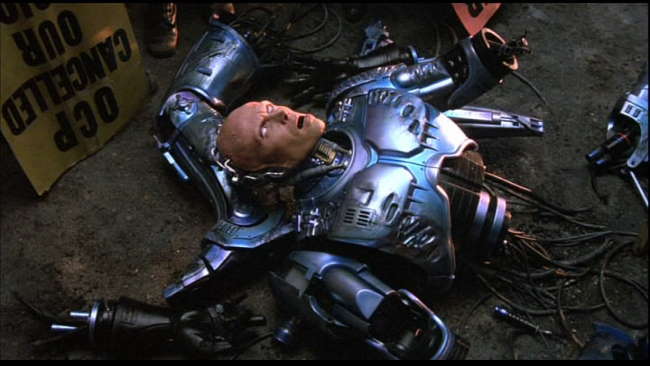
RoboCop, getting his ass handed to him.

Film: RoboCop 2 (1990)

Director: Irvin Kershner

Starring: Peter Weller, Nancy Allen, Tom Noonan

Written by: Frank Miller, Walon Green


I’m not going to argue that the sequel to RoboCop is better than the original (especially since Red Forman died in the first film), but I will say that RoboCop 2 is a great sequel that pushes the story of this ghost in the machine into bold, inevitable territory.  The first film was funnier, sure, and it did have Red Forman killing fools and maligning bitches, but the second act is frighteningly prophetic.

RoboCop’s creators in the industrial conglomerate OCP were portrayed in the first movie as sort of a Shakespearian collection of backbiters and scumbags, yet they weren’t really the story’s villains.  Sure there was a villainous VP who closed the film on the receiving end of some iron justice, but for the most part RoboCop spent his days taking out the ground level trash and left the white collars to scheme.  In the second film, there’s no ambiguity to it; OCP is the evil empire.  Its goal: to force the city of Detroit to default on its debts and then convert the city into its own corporate fiefdom.

Sounds rather modern, no?

Sure, RoboCop spends a good chunk of the film fighting the street trash, in this case represented by a drug cult comprised of an ecstatic Tom Noonan, a member of the Memphis Mafia, and a monstrous little shit that shoots RoboCop in the face.  Yet it quickly becomes clear that OCP is pulling the strings, and all the later disasters that RoboCop must undo are entirely the responsibility of the corporation.

There’s a great segment in the middle of the film where OCP’s meddling has a funnier result.  After getting dismembered by the drug cult and having his ass handed to him, RoboCop is “fixed” by the conniving head of R&D, who focus groups him into irrelevancy.  Thanks to the input of nervous soccer moms, RoboCop’s four Prime Directives grow into hundreds, and the bureaucracy forces him to behave so benignly that he’s completely useless.  Breaking up a robbery perpetrated by an evil Little League team, RoboCop gives the kids (and their dead coach) a stern talking-to, which they promptly ignore.  Then he opens fire on a guy enjoying a cigarette.  So great is the idiocy that our hero finds no other option but to open up a power station and electrocute the stupidity out of himself.  If only it were so easy for the rest of us.

I really like RoboCop 2, even if the end involves a battle to the death between RoboCop and a junkie deathbot.  Films like the RoboCop series are a good reminder that all the political and corporate shit we’re dealing with now is nothing new.  People decades ago knew where we were headed, and here we are.  Perhaps we should have heeded the warnings.


Y Marks the Spot: I’ve come to Loathe You, Music

YOUR FUTURE HERO.


There was one lucid moment in the past year of my musical breakdown which sums up the silliness and absurdity of music as culture.  It happened around the time of Rebecca Black’s “Friday,” a fantastically brainless musing about partying and the days of the week that, with the help of the internet, turned one hapless teenage girl into the Antichrist.

Maybe it’s because I’ve come to cherish the weird and terrible instead of condemning them; maybe it’s just because I’ve stopped defining myself by what I’m entertained by.  In any case, I didn’t get the outrage against “Friday.”  If I was 16, still awash in brand name rebellion and mass marketed introspection, I’d probably have gotten offended and howled for her head with the rest of the uppity jackasses.  So here’s one more reason why I’m glad I’m no longer 16.  It’s a dumb song.  The end.  Get over it.

It was while I was in this line of thinking that I was treated to a performance of late 90s pop classics sung by a room full of girls drunk with nostalgia and beer.  So many songs that I actually did rail against back in the day, songs I was sure would bring about the downfall of civilization, were being sung in earnest by people who this night acted like this music was civilization’s apex.  I’ll admit that I had to get out of there after the third Spice Girls song, but I also realized that someday Rebecca Black, Justin Bieber, and the next test tube babies from the Disney Channel and American Idol will be the elder statesmen of all music.  “Mmmbop” by Hanson is no less absurd than “Friday,” but it’s more tolerable because it’s not happening now.  Because it’s history, and thus safe.

Beyond this moment and a few others, my past year has been spent loathing the grand idea of music.  This isn’t to say that I’ve spent that time in silence; in fact, I’ve often clung to music as a means of evasion and inspiration.  But any and all moments when music went beyond my headphones and me and became social in any way drove me nuts.

The earliest break was a continuation of a problem I’ve had since I began reviewing albums four years ago.  Essentially, I think music journalism is bullshit.  I knew it was bullshit when I started doing it, and I think it’s bullshit now, and there has never been a period when I didn’t believe this.  Even more than any other form of media, music works on a visceral, personal level.  Attempting to foist your tastes upon someone else, especially in the impersonal realm of media propaganda, is as illogical as it is invasive.

The last year has seen long stretches of time when I threw up my hands and stopped being a music journalist, but I’ve never quit for good.  The question arises: if I hate music journalism so much, why am I still doing it?

The first and easiest answer is that I don’t write about music for music’s sake but for writing’s sake.  I don’t want to be some desperately hip tastemaker.  I’m fine with giving my opinions on a thing, but I don’t have the attitude that my opinions are law.  In fact, I don’t really care if anyone picks up an album at my suggestion.  I write to write, and I write for myself.  Reviewing albums is good, constant exercise.

More importantly, I also review for myself.  I’ve found quite a few really good albums that I wouldn’t have discovered had I not been reviewing music on a semi-regular basis.  Even as I loathe the telemarketing aspect of music journalism, I’ve personally benefited, learned, and grown as a result of pursuing it.

My final point on why I write about music is that I’ve found that I really like interviewing people.  A review is black or white, life-changing or total shit, but talking with people about what they do provides a lot of context to the work that is sometimes wonderful to discover.  I did have a bit of a meltdown in the past when I realized that, with the possible exception of David Bowie, every musician in the world is going to answer the question of what sets them apart with the cliché that they’re honest and real.  Nonetheless, I get much more out of interviewing than being a product shill (and in media, even when you’re savaging a product, you’re shilling it).

The other big reason behind my break with music comes back to age.  Just as I no longer take music I dislike as heralding the apocalypse, so too do I no longer tie my identity to music I do like.  I have favorite bands, I suppose, but my sense of brand loyalty is gone.

Furthermore, I’m falling out of the target audience.  Pop music is a teenager’s game, and I’m a decade past the expiration date.  I’ve heard the same lyrical themes of phony, desperate romance and phony, triumphant rebellion for my whole life.  With every repetitive sentiment music becomes more pointless.  I’m kind of over it, which means that music is kind of over me.  It’s a strange and occasionally alienating feeling, but one I can live with.

Music, I still like you, even if you do sometimes act like an obnoxious twit who doesn’t realize that you’re wallpaper, not religion.  We’ll be friends for life, and nothing will change that, but the time has come for a little clarity between us.  It might help our relationship if you occasionally shut the fuck up.

  • Calendar

    • December 2025
      S M T W T F S
       123456
      78910111213
      14151617181920
      21222324252627
      28293031  
  • Search