Bizarro Masterpiece Theatre: Stephen King’s The Shining


Film: Stephen King’s The Shining (1997)

Director: Mick Garris

Starring: Rebecca De Mornay, Steven Weber

Written by: Stephen King


I’ve made it no secret that I really dislike Stanley Kubrick’s version of The Shining.  By the time I watched it all its horror moments had become cliché, but after reading Stephen King’s much better source material I’ve come to hate it pretty thoroughly.  What was supposed to be a story about a family trying to keep itself together and a father trying to overcome alcoholism and pull his life together became in Kubrick’s hands an artsy horror shitshow featuring Jack Nicholson as Wolfman Jack Nicholson and Shelley Duvall as a mousy, goggle-eyed fashion atrocity.  If Nicholson’s Joker and Duvall’s Olive Oyl were swapped in for their characters in The Shining, no one would be the wiser.  Sure, it’s fun to watch Nicholson go nuts and abuse his family, but he’s not exactly my go-to actor for sympathetic characters, which was what his role should have been.

I’m not the only one who thought that Kubrick crapped all over Stephen King’s book.  King himself had a lot of hate for the film.  Years later, this culminated in his creation of a better, fuller miniseries version.  The miniseries form, usually about three or four times as long as a feature film, has usually been better suited for adapting King’s better-known books, and this version of The Shining maintains that trend.

Still, casting, not length, makes this version superior.  The decidedly not wolfish Steven Weber makes for a great Jack Torrance, and watching him descend from flawed but well-meaning dad to grinning, bloody monster (appropriately enough, he’d have made an awesome Joker) is more gripping than Nicholson playing Nicholson.  Rebecca De Mornay plays Wendy Torrance as she was written: a young, good-looking mother whose default setting wasn’t as her husband’s emotional punching bag.  Their psychic son is still played by a creepy kid, in this case a chubby, bowl-cutted kid who seems incapable of closing his mouth (I ended up referring to him as Cheeks).  Still, I’ll take this kid over the shaggy creep from the original who talked through his finger and had all the acting chops of a stroke victim.

I also really liked the horror elements in this version.  In addition to actually explaining why the Overlook Hotel was a hellish purgatory (instead of Kubrick’s waving his dick around and cramming random spooky shots together), the ghosts in the place are both restrained and horrifying when allowed to break loose.  The rotting chick in the forbidden room is actually kind of terrifying, as opposed to the old hag who tricks Nicholson into making out with her and laughing at him afterwards (it was pretty funny).  The head ghoul is an awesome shade of Dracula who owns any scene he’s in and is genuinely menacing.  I’m also really glad that the evil hedge animals made the cut, instead of being replaced by a lame hedge maze in which Nicholson gets tricked (again!) and freezes to death.  Oh yeah, the ending is a little better, too, which is to say that it actually has one (even if it is pretty sappy).

Suck it, Kubrick.


Y Marks the Spot: Sans

How I Deal with These Things

ONE

The main consolation of my hectic meltdown in the last week in October was that my final grandparent barely suffered at all.  In fact, my grandmother lived on her own right up until she had the stroke which sent her to the hospital for the last few days of her life.  Until then, she could drive, and walk, and take care of herself.  Even after that point of no return, she remained more or less herself until she fell asleep on a Sunday afternoon and died shortly afterwards.  She was 87.  I can’t imagine many better ways for an 87 year old to die.

Before that finality, I hovered at the edge of the country, waiting to find out where things were headed before I made any concrete plans to return to the Midwest.  I got word of the end while in a grocery store, holding onto a box of Wheat Thins with one hand while trying to cram my phone into my ear with the other so I could decipher the sobbing voicemail that was nonetheless crystal clear.

After taking a moment in checkout to adjust to the thought of someone important permanently vanishing, my on switch flipped.  I don’t think that, over the course of the next week, it ever flipped back.

The first order of business was to let my jobs know that I was vanishing.  I’ve heard tales of the management of my crappy burger cult job being unbelievable assholes to people wanting to attend funerals, so I did my usual cult-fighting tactic and sent my boss a text, leaving no room for negotiation.  The other job was much more supportive, even if that well-meaning boss waxed the usual sympathies.  From there I got completely fleeced on a flight ticket and spent the following day wearing myself out from the hurry up and wait that comes with automated travel across the country.

It was on the midnight drive between the Minneapolis airport and La Crosse when I learned that my grandmother’s death wasn’t the only catastrophe to happen to my family that week.  I will give absolutely no details as to what happened but to say that it was something horrible, and it made a terrible week so much worse.

Further piling on the week’s mountain of blues was the shadow of my Crazy Bitch Aunt, who tried to return from family exile to insinuate herself into and take over the funeral proceedings.  The condescending shrew’s classiest sociopath tactic involved phoning my mom over and over and telling her – the person who stayed with their mother from stroke to death – to act like a grownup.  Luckily, Crazy Bitch Aunt didn’t show, but the threat of her prancing in and wreaking entitled havoc sparked apprehension in all of us at a moment when none of us needed it.

The proceedings went about as well as such things can go.  I avoided my grandma’s corpse at the wake because its makeup and smoothed face made the body look alien.  I almost disrupted the funeral when I had to fight back a violent seizure of laughter at the expense of the pastor who kept staring at the ceiling instead of at the crowd.  I’m glad my friends were sitting on each side of me to cover it up.

On the upside, I met a cousin’s brainy kids at the wake and got to dispense writerly advice to them.  I also came up with the idea for an amazing Dadcore band called The A Little Goddamn Respects at the lunch following the funeral.

But what I didn’t do much of in that hectic week was think about my grandmother.  In all the rushing around to get to all those regimented ceremonies of remembering the dead, the person being remembered kind of got lost in the shuffle.  Sure, I had a twinge of horror and revulsion at the wake, and I spent the week living in her house filled with her artifacts.  But I’m not sure if I’ve been able to be affected by the death of this person who had known me all my life.

I don’t think I do death, if that makes sense.  Though I’ve become absolutely horrified at the thought of me no longer existing, I also have this detached view in which I view the death of a person with the same sense of pain as I’d feel from the loss of all the data on a computer that hadn’t been backed up.  (When my grandpa died, I was the first person to see his corpse, and all I did was take its picture, as seen above.)  In this mindset, death is wasteful, illogical, but not agonizing, void-creating.  It’s certainly a safe rationalization.

I definitely don’t do funerals.  I don’t do outpourings of grief, and I don’t react well at all to multiple people coming up to me and feeding me the exact same clichéd lines of sympathy.  The only reason I showed up to this one was for my mom’s sake, and while I’m glad I was here for her it did nothing for me.

So here’s my memorial of my grandmother, weeks later, all cold text and white paper.

She may have been the smartest person in my family – she certainly was the most refined – but I still got her to call me a retard once.  She didn’t mean it to be funny at all, which made it incredibly funny.

She was also responsible for my incredibly vulgar Halloween costume three years ago: the bloodsucking feminine product known as the Tampire.  I’m a lazy Halloween participant, but when I described this old joke and flippantly said I could dress up as one of these creatures, she looked at me, calm as space, and said, “I think you should do that.”  After that, I had to.

The last time I saw her alive was last Christmas, a time in my life when I had no job, no money, and was sleeping on a mattress in a flea-infested dining room.  I had Frequent Fliered my way back into town and hoboed around destitute, but when the family gathering happened, my grandma kept handing me envelopes containing fifty dollar bills which kept me afloat for a few months.  My final memory of my grandma is of her helping me out when I really needed help.  There are far worse final memories of a person that one could have.

TWO

After and before and between the ceremonies that marked the end of my grandmother, I was left to spend Halloween week wandering around a town that no longer felt like home.

La Crosse has become different.

I’m willing to admit that much of the weirdness and alienation and oddness of wandering around my hometown that week might have come from sleeping poorly, feeling rushed from one event to another, typical Autumnal depression, and of course the fact that I was there for a funeral.  It’s true that La Crosse will certainly be different without my grandma’s house serving as the family’s home base.

But it’s more than that.  I spent a lot of time wandering around old streets, smoking my grandmother’s final pack of cigarettes – artifacts which certainly contributed to how she died.  What I noticed most in these trips were the things that had disappeared, after which I noticed the things which had altered, and then the things that were new.  The bars which had closed up were the obvious signifiers that time had passed since I had left, though I’d say that balance was secured with the reopening (and far overdue repolishing) of the Casino.  I’m really, really glad that the Casino is back.

The most startling change I noticed in my time back hit me as I walked past the Second Supper office on Main Street.  Planning on dropping in and saying hello, I instead saw a For Rent sign on the front door.  I had picked up a tiny copy of the paper while walking downtown, so I had evidence (beyond my sporadic contributions) that the Supper still existed, but it wasn’t as it was.  Combined with the fact that the Supper’s website no longer reprints its issues, that gave me a feeling of dread.

My friends who still remain in La Crosse were as they always were, and that was about as much comfort as I could wring from the week.  When I wasn’t on the job in the mourning parade or sitting around my grandmother’s empty house attempting to level myself out with video games, I got to roll around town with my gang of ne’erdowells, drinking cheaply and watching beautifully awful cinema.  We went to the Ed Gein shindig that was more performance art piece than haunted house, and I rambled through the rooms loudly wondering why they weren’t playing Killdozer’s epic musical tribute to the Butcher of Plainsfield.  We lurked around the Casino, drinking Colors of the Bar and being generally glad the place had returned to the land of the living.

Still, Halloween weekend was kind of a bust.  Reverting to my usual Halloween laziness, I donned a cheap skull mask purchased in readiness for a time when the world would need a man dressed as Skeletor.  I put on the shirt and tie I wore to my grandma’s funeral and stuck a giant duct taped M on my back and a smaller one on my chest.  With a new pair of crappy skeleton gloves, a plastic sword I’d almost immediately lose, and drunkenly grabbing some of my grandmother’s old respiratory equipment, I hit the streets as a horrible pun – the Rasputin-praising German disco band, Boney M.  Har har har.

I committed no acts of drunken awesomeness, just huddled over my screwdrivers and tried to drink through a breathing tube and a mask.  My friend, more awesomely dressed as Robin, the Boy Wonder, accompanied me through Saturday’s overcrowded boredom.  We played the traditional Halloween game of “Would She Be Hot If She Wasn’t Dressed like a Stripper?” while we hid from the crowds as well as old assholes and sociopaths from our pasts.  I suppose I did learn the liberating power of wearing a mask, if anything.

I’d spend Halloween proper flying home on no sleep, raging through plane delays and long shuttle bus rides, and unloading my tweaked-out aggression on my Vegas cop friend via internet.  It was a hateful, lost little day.

I’m sure there’s a reasonable explanation for what happened the night before Halloween.  That reasonable explanation would probably contain the lack of sleep and subsequent stress that I gained through the week’s funeral proceedings.  I’m sure that I just went crazy, but the problem is that there’s this chronic doubter in me that can’t dismiss the possibility of anything, no matter how fantastic or terrifying.

I swore I was going to get some sleep that night, and my nodding off at a friend’s house seemed to confirm this hope.  But once I got back to my grandma’s house, where I planned to collapse on her unoccupied bed, I was on like a wide-eyed light.  I went between channel-surfing the internet to watching crap TV to playing video games to getting really frustrated with my life.  Soon I downloaded some really amazing albums and wandered around the pitch black neighborhood soaring to these epics.  Almost immediately after returning from this journey, I walked right back out the door and over to my friend’s house in the dead of night, where I got a copy of the delightful Fred Schneider album which I’ve always meant to get from him.  Finally I returned to the house, where I laid down in my grandma’s bed and hoped to get a few hours’ unconsciousness.

The only problem was that, every time I felt myself fading out, something would poke me.

Like I said, I’m sure there’s probably a perfectly reasonable explanation – but at the time, I was all out of reason.  At first I turned on the light and stared at the ceiling, but after a few attempts at sleep that all ended with the same pulsating poking I got the hell out of my grandma’s room.  I paced around her hallways with flickers at the edge of my vision, attempting and failing to dull the encroaching madness with entertainment.  When my mom woke up in the morning and saw me sunken and beaten in my grandma’s recliner, she knew something had gone wrong.

I spent the next week back here, recovering in a foreign land and trying to get normal again.  I’m much happier here, and I’ve been able to sleep, at least – but I rarely feel very rested.

The Designer’s Drugs: William Shatner – Seeking Major Tom


Medium: Album

Stimulus: William Shatner – Seeking Major Tom

Anno: 2011


God bless William Shatner for having a music career – okay, a spoken-word career set to music.  Following up on his artistic and awesome collaboration with Ben Folds in Has Been, Shatner’s enunciations have returned to the grin-worthy.  At last, his aural body of work has arrived at its logical, Captain Kirk conclusion: a covers concept album about space.  If it’s a famous song that in any way references the heavens, Seeking Major Tom takes it on, swirls it together alongside NASA audio clips, and places it among the coherent whole.  He dusts off his classic rendition of Elton John’s “Rocket Man,” does the expected gloom of Bowie’s “Space Odyssey,” rambles around like a drunk uncle in “Space Truckin’,” rocks it wild on “The Twilight Zone,” and synths up his voice to ba-baba a sweet cover of Duran Duran’s “Planet Earth.”  Most of this is entirely predictable, and all of it is wonderful.

The only exception to this goodness is “Mrs. Major Tom,” a cover entirely devoid of Shatner’s presence and full of Sheryl Crow’s.  It’s an okay track, but in the context of the greater album the lack of hyperacted vocals is jarring.  There’s definitely a Where the Hell is Shatner vibe to it.

But let’s get to the mind-blowing parts.  First off, Shatner covers “Iron Man.”  It’s pretty goddamn amazing, though the focus is much more on Zakk Wylde’s guitar playing than on our hero’s sweet crooning.  Yet looming even more titanic in the category of it must be heard to be believed is William Shatner, covering “Bohemian Rhapsody.”

Holy shit (or Shat), this is amazing.  Shatner completely warps and perverts this song, throwing out Freddie Mercury’s rock opera vocals and replacing them with groans and wails and gnashing teeth.  The song becomes less tragedy and much more farce, with the lyrics under Shatner’s stewardship becoming the tale of a paranoid schizophrenic with a splitting headache.  It’s beautiful.

If you can, check out Shatner’s video for “Bohemian Rhapsody.”  Not content with warping only one classic beyond recognition, his music video is by all appearances a dissection of the Smashing Pumpkins’ “Tonight, Tonight,” in which the starry, disembodied head of Shatner sings in space and occasionally plagues the Earth with meteors.  It’s splendid.

It’s not half as respectable as Has Been (or even those songs in which Shatner howls out Shakespeare monologues), but Seeking Major Tom is the album of a man who knows his place in pop culture and isn’t afraid to ham it up to the fullest.  Now if only Adam West will make a cover album about bats.


The Designer’s Drugs: Albert Brooks – 2030


Medium: Literature

Stimulus: Albert Brooks – 2030

Anno: 2011


I’ve recently developed a fascination with American declinist literature, stories taking place not far in the future which predict the end of America’s run as king of the mountain.  In reading Albert Brooks’ excellent account of the wane of one more empire, I drew immediate parallels to Gary Shteyngart’s Super Sad True Love Story, though as soon as I did so the differences also presented themselves.  The destination of both books is the same, but the focus of each is the polar opposite of the other.  Shteyngart’s story is concerned with the clutching desperation for youth in a hyper-networked world.  It describes, almost by necessity, a more absurd, idiotic place (I hesitate to say that it is more self-obsessed).  In contrast, the world Brooks describes is being wrecked by the old, who have become an undying, retired ruling caste with no regard for the Social Security slave state it has created.  Here, the young are not venerated but marginalized and then feared as hopelessness boils over.

The colors Brooks paints with are much more sober and human.  Leaving out the flying cars and neo-Facebook crackheads, the only technology that’s really fetishized in his story is medical technology.  The cancer cure that turned 60 into the new 30 was just the beginning of the immortality industry that both elevates and plagues this world, but Brooks doesn’t have his characters speak in Internetese or act hip and futuristic.  Both the old and young are gathered together and presented as terrified, self-interested, conflicted, and most of all familiar characters.  This point is precisely what gives 2030 its power.

This wide scope also leads to some weird changes in perspective in which the reader gets into the thoughts of multiple people at the same time.  This pinball narrative isn’t unreadable, but for those conditioned to read and write a certain way, it is noticeable.  Also noticeable is a thin political vagueness that seems to indicate a desire to make the issues of 2030 beyond politics.  This is best seen in the American president, a central character who is buried under his nation’s rubble, as well as his own.  He isn’t explicitly labeled a Democrat, but his team is pretty obvious.  One of his rivals is painted as a corporate opportunist who plays the field, but his business interests in a chain of retirement homes would seem to make him an ardent anti-Kevorkian Republican.  As opposed to the contradictions and asymmetry of the characters, I don’t think this lack of definition in the big picture completely works.

This is a pretty amazing work of future world building which has easily become my favorite story of the end of the United States as we know it.  The characterization amidst the deep examination of an impending and severe social issue makes clear that Albert Brooks wasn’t simply interested in creating an American grave to dance upon.  What’s most gripping about 2030 is the possibility that he might be right about everything.

Y Marks the Spot: The First Drunkpocalypse


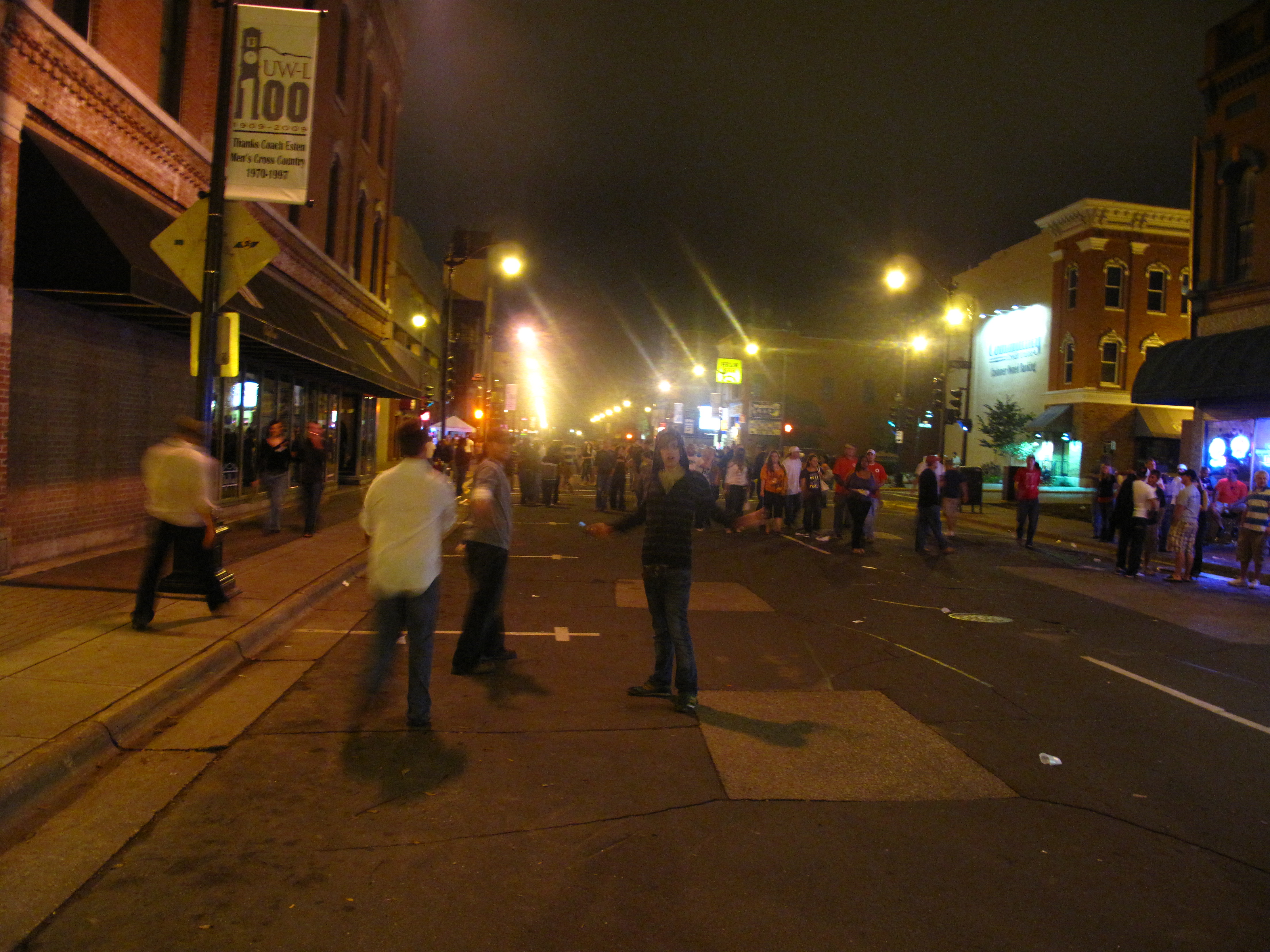
I miss Oktoberfest in La Crosse.  I miss the rabid alcoholism, the stumbling through blocked-off streets, the police horses shitting in the middle of the street, the dudes puking in the alleys, the girls crying the mascara off their faces on the edges of the sidewalks.  I miss watching the madness unfold below me as I perch on the old Second Supper fire escape.  I miss writing crass, forbidden satire about it.  I miss the chaos, and the ridiculousness, and the block party sense of community.  And lederhosen.

The first time I looked past the curtain of plastic horns, parades, and shitty carnie games of daytime Oktoberfest, I was a year too young to enter the bars.  Nevertheless, I felt compelled to wander around downtown, mostly because the skies had decided to dump snow on the festivities for that night.  It was kind of wonderful walking sober among the inebriated, watching drunks fight and celebrate, stepping over puddles of freezing puke.  I couldn’t wait to be legal for this.

It would be years before I’d enter an Oktoberfest bar.  When I was underage, all my friends were over 21.  When I became legal, all my friends became underage, so I’d buy myself booze and slip out of my brain at home.  I didn’t really go to bars until I came back to La Crosse from my time poorly spent in California (and out there, cost, not age, was the issue).  I returned to Wisconsin like a thirsty tornado, ready to commit some serious drunken psychotherapy with my friends, all of whom were now street legal.  The plan went magnificently.

These more or less high spirits led me into my first full-fledged Oktoberfest, which ended up being pretty life-changing.  The first day began with my usual work at the time, helping to set up the new Barnes and Noble in the mall.  I had found out during my shift that a fellow employee was an old high school acquaintance who had accidentally broken my glasses once and whom I had been kind of a dimwitted dick towards from time to time.  I invited him to meet up with me at the fest, but nothing came of that.

Instead, I met up with more established friends at the Southside Beer Tent, a meeting place which would have been less pointless to me had it been a Screwdriver Tent.  I sat around on benches with my thumb in my ass, blankly looking at such clever Oktoberfest banners as “2001: A Fest Odyssey!” as my friends drank beers that were to me indigestible.  At some point I also met old high school friends whom I quickly blew off.

I escaped the festgrounds with a pair of cute girls I vaguely knew and was vaguely interested in, true Oktoberfest warriors who had been drinking since that morning.  We lurked in Yesterdays in the vague hours before the crowds began pouring in, pounding down our respective drinks with good cheer.  One of the girls vanished at some point, leaving the other one to wander the streets with me as I looked for my reassembling group of friends.

We reconvened in the infant Shooter’s, where my faint hopes of hanging out with my companion were crapped on by another girl who got a she-boner over the way my spiked hair and black clothes made me look vaguely like Robert Smith (I guess).  This new factor followed me around the bar and monopolized my time, trying to excite me by employing girl-girl antics with a neighbor of mine and trying to pull me into the fray.

Looking for any way out of this mess, I grasped onto the Bruce Springsteen song that was currently playing.  I think it was “Born in the U.S.A.”.  Pushing my neck away from Boner Girl’s clutching mouth, I shouted “You show some goddamn respect for the Boss!” and stormed off.  My absurd sense of decorum came too late, though; the girl I had come into the bar with had gone.

We ditched the Boner and wandered back to Yesterdays, but at that point I wasn’t feeling it anymore.  I was crouched on the sidewalk in front of the bar, bored with the overabundance of life unfolding around me, when an exasperated-looking girl with red hair and black boots swept past me and into the bar.  And I was back.  I followed her in.

The timeline for that weekend becomes a bit fuzzy after that, but I think it goes like this: I had a large man nearly twist off my nipples in the middle of Pearl Street at bar time, my friend and I raged about some offense in our dark living room, another roommate staggered in and begged him for pot, Red Girl had a breakdown, I told her things would be fine, and she replied that things would never be fine.  Later, she and I became friends, then we ended up in a relationship for two years, and then we became friends again.  So I was right.

May Gambrinus’ grace watch over you all, you glorious drunks.

Y Marks the Spot: Stay in Your Lane

Assholes.


I really like the town where I live now, but there are two aspects of Bellingham that I could do without.  The first, being the difficulty of procuring cheap liquor, is more of a Washington state issue.  The second, being an arrogant dickhead bicyclist culture, feels a bit more home grown.

Most times I notice the schmucks riding their wheels down the dead center of the city’s car lanes and I smile at the audacity.  The broad dressed like a jockey riding her old-timey steed through the left turn lane of one of Bellingham’s busiest and crappiest streets was actually kind of awesome.  Yet when I have somewhere to be in the early hours of a weekend morning and I end up turtling along in my car behind a parade of professional spandex-covered douchebags who have taken up the entire goddamn street, my blood starts to boil.  In these moments I think of a video I saw in which a car plows through a South American bike parade, and that usually gets me through long enough to veer onto a side street.  Still, I do sometimes curse America’s stringent vehicular manslaughter laws in the meantime.

However, my irritation at my new town’s bike culture run amok comes more from my being a bike rider myself.  I don’t really like driving my car, and $4 a gallon gas and expensive insurance makes my tendency to walk or bike if I can get away with it all the easier.

But I’m also an amateur student of science, and my years of armchair research in the field of bicycle studies has led me to the discovery that my bike is neither as big nor as fast as a car.  Add to this my lifelong paranoia about being run over from behind by one of those bigger, faster machines – a fear that, when I was eight, landed me in Bike Court for riding on the left side of the road, where I could at least see the cars coming.  Yes, Bike Court is something that exists.

This combination of science and dread has led to me adopting a simple rule for when I’m on my pedal horse.  If a street doesn’t have a clear, painted bike lane, I usually stay on the sidewalk.  I’m sure the true bicyclists of Bellingham, when they see me riding around in a state of such blatant cowardice, assume that I’m also a grown man who sits down to pee.  Whatever.

Lately, I’ve been hearing a few bike crusaders on the internet calling for a War on Cars, a concept that is pretty fantastically ridiculous even beyond the basic truths that cars are useful and America is a big place.  If this oh so bold stance came from a line of thinking that included (or at least mentioned) mass transit, I’d be more okay with it, but the rhetoric of the War on Cars people just makes them come off as spoiled dickhead bicyclists who think that they’re the center of the universe and think that that cars can just idle along behind their puttering asses.  According to this prejudice, these helmeted revolutionaries would take the interstates if they could.

Sure, I absolutely support the creation of bike lanes everywhere, though the established structures of cities makes universal application impossible.  I’d like to be able to bike wherever I need to go.  I’d like to not be hit by a car, and I’d like to not run over a pedestrian (side note: how many pedestrians are calling for a War on Bikes?).  The thing is that these ideals don’t have to put bicyclists at cross purposes with car drivers.  Calling for a war on competing forms of transportation is both silly and dramatic – unless the form of transportation is a Segway, in which case it’s totally justified.

It’s been an increasingly accepted idea that streets are meant to be shared between cars and bikes, and I agree.  But when I’m driving to work on a bleak Saturday morning and I have to drive 15 miles an hour behind a four-wide bike parade, well, they’re the ones who aren’t sharing.  I have the prejudice that more than a few bike snobs are the sort of people who think that the average car driver is this spoiled and loud creature who could care less about the rest of the world so long as he’s comfortable.  To those fulfilled bike snob stereotypes, I ask this: when your small, slow asses take up the entire street when they could easily and comfortably fit in a much smaller space, are you any different?

Y Marks the Spot: Turd Ferguson

My new neighborhood is very cat friendly, to the point where gangs of the mild mannered beasts roam its narrow streets with impunity.  They sit around on the sidewalks, gazing at human pedestrians, and if you walk up to one of these furry loiterers, it won’t mind a gentle scratch on the neck.

So I wasn’t surprised when, a few weeks back, I noticed a cat slinking into my secluded backyard, making its way into my moss-covered and dilapidated shed where it made camp and stared at me through my back room window.  The unusual part happened when the cat stuck around.

It was a bit too easy to befriend this animal, even for our neighborhood.  The first time my girlfriend went outside and held out her hand, the cat ran right over and they were instantly friends.  Seconds later, I made my first formal acquaintance with the creature, and we were all pals.

We named the cat Ferguson, because it was, while a handsome creature, also a matted-fur longhair with turds hanging off its ass.  This led to a lot of awkward dodgings when the cat did what normal cats do and obsessively tried to rub itself against our legs.

But the desperation in the animal was radioactive.  From the point of introduction, Ferguson slept in our backyard under a far off tree at the corner of our fence, and it didn’t leave.  Any time he saw motion in our back room and any time we went outside, he would rush out from the shadows and rasp at us for attention until his voice grew hoarse.  Ferguson sounded like a cross between a chain-smoker and the annoying fairy from Ocarina of Time.  Hey!  Hey!  Listen!

Ferguson wanted in our house because it was obviously a housecat that had been abandoned.  The facts that he was declawed and extremely comfortable with humans as well as his refusal to leave our backyard once he set up base were strong proof that Ferguson once had an owner who didn’t deserve him, and he wanted us to fill that space.

If my girlfriend and I didn’t already have two spoiled, absurdist kittens, we’d have taken Ferguson in following the quickest of groomings.  But that wouldn’t have been fair to the beasts we were already responsible for.  After we brought them to our new sanctuary they were just as shell-shocked over the new solitude as we were.  A new cat would have wrecked them, so that wasn’t going to happen.

We did what we could to help him out: scooping food out onto the grass, filling up a can with drinking water, coming out to be around this sweet, neglected creature.  But we couldn’t give him what he wanted, and there was a lot of guilt that followed each time we went back inside and shut the door on him, leaving him to stare through our blinds at an impossible safety.

We wouldn’t have let this situation stand under normal circumstances, but being that the weather was getting colder we decided that we had to find Ferguson a home as soon as possible.  I put up a few feeble posts on Facebook to little avail, but my girlfriend had better luck.  A coworker of hers was an established adopter and rehabilitator of strays, and she was looking for a second cat.  After a few text conversations, the coworker walked into our backyard with her family and was immediately love-mugged by our feline hobo.

And that was that.  The family returned the next day and took Ferguson off to the vet, after which he was taken to a home where I’m told he’s very comfortable and happy.

Once all the turds were snipped away, Ferguson ended up being a girl.

The Designer’s Drugs: Glorious Nintendo 3DS First-Year Plan

EPIC!


Medium: Game – Portable

Stimulus: The Nintendo 3DS First-Year Rorschach

Anno: 2011


Last Friday, I picked up a brand new fire red Nintendo 3DS.  I’m pretty pumped about my new acquisition.  I can take or leave the 3D screen option, as it’s pretty hard to maintain a steady gaze and fight off the eye strain.  But I love the improved touchscreen, which is so much more responsive and usable than the old clunky Nintendo DS screen.  The inclusion of motion sensor controls on the system, in which you get to aim the screen instead of simply aiming a controller, also works wonders.

I’m pretty skeptical about game systems in their first year.  The hardware can get pretty buggy, and a solid collection of titles doesn’t develop until at least the second year of a system’s life.  Yet I found four games for the 3DS that looked good enough to merit picking up this new piece of technology, and I obtained them all.  Three of these games are remakes, and one is an established minigame set loose on its own.  Yet each one is a blast; even the worst of the bunch is above average.

Submitted for your approval: the best of the Nintendo 3DS, thus far.


Super Street Fighter IV 3D Edition:  I remember getting written up at work for Protestant-bashing on a St. Patrick’s Day years ago, ditching out to take an extended break at Best Buy, playing the original version of this game there, and feeling okay with the world.  This is the better version of that game.  It plays as great as I remember, but the real star in this edition is the touchscreen, which is an absolute godsend.  No more fighting like a thumbless, black eyed chimp trying to enter convoluted commands to execute one’s special moves; the four touchscreen buttons can be programmed to bust out any command with a simple tap.  The simplicity is breathtaking.


Resident Evil – The Mercenaries 3D:  The weakest of my four purchases is still a fine game.  The premise of this minigame turned full release is simple: choose a character, choose a mission, and shoot as many zombies as possible before time runs out.

The Mercenaries does have a few issues, though.  It suffers from a weird form of slowdown when there are many baddies onscreen, in that the zeds furthest away seem to run around in a stilted slow-motion.  Also, this is not a game to go in for the long haul; missions get pretty monotonous quickly.  This one seems built for multiplayer.

Is it worth new game price?  Probably not, but The Mercenaries is everything good about Resident Evil ultraviolence distilled into a quick little injection.


The Legend of Zelda: Ocarina of Time 3D:  This is the flagship, the standard-bearer of the 3DS.  There is no question.  In what seems to be a trend with this system thus far, Nintendo took a decade-old game for the Nintendo 64, made it beautiful, and added some neat tricks to the gameplay.  The result is not only an epic, sprawling quest that doesn’t feel old, but also a game that is far superior to most new releases.  Vital and magnificent.


Starfox 64 3D: Nintendo’s other big rerelease from the Nintendo 64 days is a pretty slick update on Starfox 64’s classic of space combat.  The big selling point of this version is the ability to steer one’s spaceship with the 3DS’ motion controls, which is a cool feature but also one I think works best in combination with the traditional and more stable analog stick steering.  Again, this is an old game that has much more life in it than a lot of new games have.


The verdict?  The 3DS is worth the purchase.  It doesn’t hurt that the system’s price just dropped a hundred bucks, either.

Little Girl’s Tea Party Draws Inappropriate Crowd


Waukesha, WI (AP) – When little Daphne Johnston, a girl of five, announced to her kindergarten classmates that she was hosting a tea party, she had no idea of the outpouring of rage she was in store for.

Last Sunday, the home of little Daphne Johnston was the unwilling host of a massive political demonstration held by members of the Tea Party Patriots, liberal counterprotesters, and, bizarrely enough, members of the Epsilon Omega fraternity.

Dirk Diamond, head of Epsilon Omega, explained the misunderstanding.  “When we heard about this rockin’ tea party, my broskis and I just thought that there was an all you can drink on Long Island Iced Teas!  Our bad, bro!”

Yet only Epsilon Omega remained in high spirits.  To the horror of the pint-sized hostess, what was to be a dainty, well mannered affair quickly degenerated into hundreds of Waukesha citizens screaming at each other over hot-button issues such as same-sex marriage, immigration, and Governor Walker’s attempt to eradicate public unions.

Thankfully, violence was averted, but a little girl’s hopes and dreams were crushed.

“They called Mrs. Kendrick a lazy, spoiled, godless socialist!” Daphne cried after the rally, tears running down her face as she described a Tea Party member’s verbal assault upon her kindergarten teacher.  “She’s such a nice lady!  She taught me how to count to twenty!  Why would anybody say that?”

Daphne’s mother Roxanne was so distraught by the demonstration that she bought ten bottles of Long Island Iced Tea and bribed the brothers of Epsilon Omega to chase away the protesters, which they did in short order.  With peace regained, the frat boys were invited by Mrs. Johnston to stay and attend her daughter’s tea party, where they sipped Long Islands from tiny plastic teacups, content with having made the world better for one little girl.

“I say,” Diamond quipped to his little hostess, his pinky held aloft from his tiny teacup, “your mom’s a total MILF!”

Daphne giggled, having no idea what her new friend had just said, and handed him a purple stuffed pony.

Labor Day Groundhog Sees Own Shadow, Predicts Six More Months of Severe Economic Disparity

Kill the poor!

SCOTTSDALE, AZ (AP) – Carrying on a tradition that hails back to the inauguration of Ronald Reagan in 1981, the citizens of Scottsdale celebrated Labor Day with the unveiling of Scottsdale Sam, a groundhog used to predict the nation’s immediate economic future.  This year’s festivities were attended by such American luminaries as Texas governor Rick Perry, former Alaskan governor Sarah Palin, and Maricopa County Sheriff Joe Arpaio, and the celebration went off without a hitch.

Climbing through a patch of overly irrigated green desert lawn, Scottsdale Sam surfaced at 12:37 pm (though various reports have the time at 11:37 am, as Arizona doesn’t believe in Daylight Savings Time).  Surrounded by a diverse audience of highball-drinking country clubbers, heavily armed rednecks, and Tea Party Patriots dressed as the Founding Fathers, the groundhog sniffed the dry desert air for a moment before abruptly glaring at the crowd and darting back into the imported soil, signifying six more months of consolidation of the nation’s capital in the hands of the extremely wealthy.

Cheers immediately rose from the crowd, followed by chants of “Don’t retreat, reload!” and a Mariachi band performing a rendition of the Dead Kennedys’ “Kill the Poor.”  Soon after, the audience began firing assault rifles into the air.

A nine year old girl, yet unidentified, was shot and killed in the crossfire, but since Arizona legalized the shooting of nine year old girls at public rallies following this year’s assault on Congresswoman Gabrielle Giffords, there was little outcry.  The body was quickly removed by the help.

“Oh Jesus, this is the best time!” Governor Palin exclaimed to the boisterous crowd.  “Scottsdale Sam has once more proven what the rest of the nation already knows: that you people are what makes this nation great!”

Squinting into the sunlight, Palin adjusted her gaze and pointed toward a group of high-powered bankers lurking around the bar.  “Wait,” she addressed them, “I mean you people are what makes this nation great!”