Y Marks the Spot: The Human Shields


My best friend is in training to someday take the reins of his family business.  In the course of this education he has had to learn some hard truths of business, and he has been required to do things in the quest for the bottom line which don’t exactly fill him with self-worth.  I’ve had a few conversations with him in which he has freaked out over having to lay off veteran employees, or in which he wonders whether he might be a little too good at being a company man.  While unlike me he has a family and thus the sort of obligations which tend to fade younger principles, we’re on the same page on just about every ideal.  The main difference between who we are today is that he can better pass as normal.

After the recent madness descended upon Wisconsin, my first conversation with my friend naturally involved me asking him whether he was getting flak for being a businessman.  I didn’t get the impression that he was being painted as a greedy villain, and he came out pretty hard against Walker’s power grab.  However, he did note that he is dreading what he may be forced to do as a local businessman as a result of trends set by corporations.

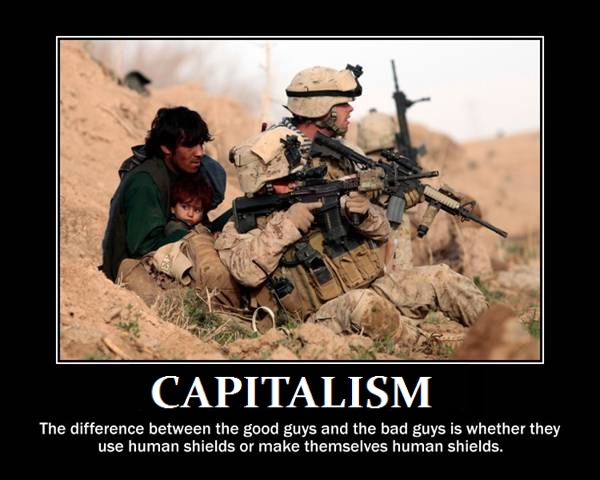
His dismal outlook on the matter, combined with many other such conversations I’ve had with others in the past few weeks, led me to articulate a viewpoint that has been solidifying in my brain during the Wisconsin protests.  Small businesses are the human shields of corporations.

As a term, capitalism is as outdated and indistinct as punk rock, and yet the real genius of its most extreme adherents is that they’ve managed to keep it in the public lexicon.  What this does is create a universal economic banner that has little basis in reality, perpetuating the myth that an attempt to stop the excesses of corporations is an assault on small business.  Captains of industry take the lion’s share of the profits, but when it’s time to talk taxes and regulation it always seems like the world’s Joe the Plumbers get trotted out with sob stories about how the government – never the corporations themselves – are out to destroy their grassroots hard work.  We saw this during the 2008 financial meltdown; we’re seeing this in today’s union-busting fever, and we’ll see it so long as small businesses are allowed to survive.

A parallel argument tends to paint all critics of unfettered capitalism as hardcore Stalinists or Maoists.  I saw this during the current conflict, as Rush Limbaugh went on a typical troll and deemed Madison “Moscow West” – as though Madison’s communities of college students, artists, Packer fans, and hippies would be down for running gulags and engineering mass famines.

Though I’m usually one of these dirty critical commies, I can’t deny that big business serves a great purpose.  For good and ill, big businesses connect consumers and distribute products in a way that small business can’t, which results in greater commercial egalitarianism.  Chain stores have better hours and catalogues than small businesses, and it’s easier to get a job in a big company (I’ve found most small businesses to be rather cliquish in their hiring practices).  Our modern, costly state of high technology is almost wholly beyond the reach of grassroots business.  For all their sins, corporations fill a vital role in our world.  The problem is that they rarely hold themselves to that role.

Let’s not delude ourselves into thinking that small businesses and large corporations are the same creatures with the same interests.  Let’s not act as though the same laws of taxation, the same labor conditions, and the same levels of government regulation can be applied in the same manner to both large and small businesses.  They can’t.

Whereas franchise stores are interchangeable clones worked by faceless staff, backed by enough money and advertising to steamroll over any resistance, the survival of small businesses depends entirely upon the connections they make with their communities.  This isn’t a necessary consideration for Wal-Mart, or Best Buy, or any company who can afford to sell its products for less than it paid for them.  Consumers may flock to dirt low prices, but when corporations use those profits to shut down every small business in town, the customer truly gets what it paid for.

So why don’t we completely divorce the two concepts and acknowledge that small businesses and corporations are completely different, often competing species within the capitalism genus?  Let’s coin new terms for the economic disciplines of each and stick to them in the public discourse, so as to avoid the confusion and blurred lines which screw up all discussions of capitalism.  So far, the best word I’ve thought of to describe the work of small businesses is localism.  I’m not the biggest fan of that term (too bad socialism was already taken), but corporatism works just fine to describe the other side.  Of course, it’s always profitable for the big shots to duck behind the bodies of their less powerful counterparts, so don’t expect to ever see this separation mentioned in the mainstream.  But that’s the fun of living in a post-media world in which the mainstream is fairly irrelevant.

Keep these distinctions in mind the next time the elected monkeys raise a stink about taxes, redistributing the wealth, or any other obstacle which threatens the impending dollar feudalism.  People like my friend aren’t the only human shields at big business’ disposal.  We are all cannon fodder, if we allow ourselves to be.

Y Marks the Spot: The Payoff

This is what freedom looks like.

The great thing about cynicism is how sensible it is.  The old adage that life sucks and then you die is as truthful as it is cliché.  I’ve long been a resigned believer in Thomas Hobbes’ idea of the State of Nature, in which every living creature is eternally at war with each other.  In his philosophy, that war is avoided by becoming a monarchist buttlicker.  I only disagree with the last part.

Living creatures may not spend every moment engaged in conflict, but it certainly seems as though it’s our default setting.  The history of humanity is essentially one of murdering the hell out of everything in our way, and once all the competition was out of the way, humanity turned on itself.  Hobbes may have felt that civilization was the remedy to the war of All against All, but I think civilization is simply the stage for the war’s next evolution.  Destruction has just been upgraded to less violent forms of exploitation.

If Hobbes’ war is to end at our hands, and if humanity’s existence is to serve any positive purpose, humanity must turn its back on its history and instincts.  We must replace destruction and exploitation, in all forms, with all their inherent neediness and weakness, with systems that are a little more constructive and self-reliant.

Until that happens, cynicism is smart business.

A few weeks ago, writing in regards to the popular uprisings in Egypt and Tunisia, I once more played the devil’s advocate.  In that article, I sniped that it would take a lot for Americans to set aside their toys and gadgets and stand up for their rights in the same way that those impoverished citizens did.  I believed in what I wrote.

I’m going to let all of you in on a secret, one probably held by most, if not all, chronic cynics.  When I howl about how humanity is a willfully ignorant, spoiled and murderous species that more often than not is unworthy of its existence…

I’M ASKING YOU TO PROVE ME WRONG.

Last week, I discussed the two moments when I was embarrassed to be from Wisconsin.  Now, let me tell you of the moment when I was the most proud of my homeland.

The way I’ve been explaining the madness of recent Wisconsin politics is as follows: last November, Wisconsin shit the bed, and now it’s trying to clean the sheets.  I’m not forgetting that Dubya Walker was elected by the people of Wisconsin, but as I’m a person who views voting as token liberty it’s probably unsurprising that I feel that democracy doesn’t begin and end with elections.

Last week, thousands of Wisconsinites proved me wrong and stood up against unbridled corporatism.  There’s little need to recap the events, but I will say this to the Wisconsin protesters: what you’re doing is everything I’ve ever wanted to see in my fellow man.  What you’re doing is the greatest, truest exercise of American liberty in my lifetime.  I’ve been waiting my entire life to see this moment, when my perpetually frustrated idealism concerning the potential of my neighbors was finally justified.  As a result of the Wisconsin protests, I’ve spent the past week in a state of fixated euphoria.  I’m so proud of the brave people of my home state for being the ones who delivered the payoff and started a movement that will become much larger than Wisconsin.  I really, really wish that I could have been there to be a part of it.

I hinted at this in last week’s column when I – using logic! – called Scott Walker a motherfucker, but allow me to fully explain my personal stake in the Wisconsin protests.

My mother does not toe a party line, a quality which she passed on to me.  She’s usually pretty right-wing and solidly Christian, though in that whole compassionate, Golden Rule style that’s so unpopular among modern conservatives.  We disagree on many things, but we can usually find a consensus.

My mom is an education assistant in a Wisconsin public school.  She works with the angry kids in a high school, which essentially boils down to her trying to get them to stop freaking out and do their homework.  It’s not easy work by any stretch of the imagination, but it’s a job which gives her the satisfaction of doing something worthwhile.  In fact, she gave up a career setting up million dollar contracts with major corporations to do it.

After over a decade, my mom now makes a little over $15 an hour.  Not bad, but not exactly aristocratic.  Really, the big financial payoff to the job is the benefits package, which includes a pretty reliable medical plan.  A reliable medical plan comes in handy when a person develops a degenerative disease in one’s neck and requires periodical injections, delivered via huge goddamn needles, into one’s spine.  Which is what is happened to my mom.

Another thing that comes in handy is a stockpile of sick days which one can use if a medical condition – like, say, a degenerative disease in the neck – renders that person unable to work.  If Walker has his way, both the reliable health plan and the sick days are gone, and if my mom – who just turned 60 – suffers some medical catastrophe, she may well lose everything she has.

If that happens, Scott Walker will have truly fucked my mother.

To the Wisconsin protesters: you are fighting for my mother.  You are fighting for yourselves.  And you are fighting for the better nature of humanity.

Thank you.  Don’t give up.  And stand up for yourselves more often!

Y Marks the Spot: Power Corrupts

There have been but two times in my life when I was embarrassed to be from Wisconsin.  Not just homeland angsty and wanderlusty, but full out What the Fuck.  The first time happened during Brett Favre’s final year with the Packers, when I had to deal with hordes of weepy Sconnies who lined up for hours and rampaged through my store every time Sports Illustrated released a commemorative issue with the QB on its cover (this happened three times, if I remember correctly). To be diplomatic, it got pretty out of hand.  This statewide mourning is made all the worse when I wonder how many people tossed their memorabilia once Favre went rogue and rendered all that weeping and wailing pointless.

But my pretty intense annoyance during the Favre Funeral is small potatoes compared to the shame I felt when Wisconsin went insane and jumped on the Tea Party bandwagon in last year’s elections.  The most embarrassing of these contests saw Russ Feingold, the only senator who voted against the Patriot Act in the knee-jerk of 9/11, a senator whose recently castrated McCain/Feingold Act attempted to stop the wholesale purchasing of elections by corporations, beaten by Ron Johnson, a Tea Party stooge who fully subscribes to the repressive solipsism (translation: Fuck the world, I’ve got mine!) that’s so popular among good, moral conservatives these days.

As I watched Wisconsin lose its shit on Election Night, I watched Johnson say something in his acceptance speech that really stuck with me and set the tone for where Wisconsin is likely headed.

“Our nation has dug itself a very deep hole,” Johnson said, “and we’re just simple Wisconsin folks here; we know what needs to be done trying to get out of a deep hole.  You first have to start digging.”

Aside from the fact that I really hate the stereotype that all Wisconsinites are aw-shucks bumpkins, I’d think that the best way to get out of a hole would be to give climbing a try.  Apparently, Wisconsin’s new senator believes in digging deeper.  That will end well.

Johnson certainly talks a good game of batshit.  In terms of action, however, it seems as though the senator is getting overshadowed by the state’s new governor – or as I’ve come to refer to Scott Walker, Wisconsin’s Dubya.  Running a campaign based on a promise to kill off any chance of Wisconsin getting a respectable mass transit system, one of Walker’s first acts upon winning the election – not even waiting to take office – was to pull the political equivalent of a child throwing himself on the ground and screaming its head off.  The light rail project, Walker demanded, would die, on the sole reason that he said so.  As a result, then-governor Doyle totally lame-ducked and abandoned the project.

Now Little Dubya is going after public unions, stating that he will completely destroy their right to negotiate the terms of their employee’s working conditions.  And if anyone disagrees with him, tough shit.  Once again, Walker is attempting to push this through with absolutely no respect for process.  Apparently he believes that “because I said so” is an adequate form of governance.

I’d call that a form of dictatorship.

Scott Walker is a motherfucker (and being that my mom works for peanuts in Wisconsin’s public school system and is part of one of the unions he’s going after, I feel rather justified in calling Scott Walker a motherfucker).  But let’s not pretend that this jackoff’s blatant power grab is unique to his position or political ideology.  No person in any position of power, whether it lies in business, politics, the media, or even those very unions, should be viewed as anything better than a potential bastard.

I know that America’s collective attention span runs about as strong as the amnesiac from Memento, but I think it’s pretty ridiculous that some on the left end of the fence, people for whom the excesses of the Bush administration should still be an open wound, find fault with Obama for not acting more like his predecessor, as though tantrum government can be excused for the right cause.  Why couldn’t Obama ram through a repeal of Don’t Ask, Don’t Tell or a health care plan that isn’t completely profit-based?  Well, because if he did that, who’s to say what else he could get away with?  Lefty as I may lean, as much as I think Obama’s brand of political cool is the best thing to happen to politics in ages – and as much as I’d like to live in a country without second-class citizens and a little Canadian-style health care – free reign is something that nobody, anywhere, ever, should have.

While I’m far from being a Founding Fathers fetishist, I strongly feel that the concept of checks and balances, popularized in its current form by Montesquieu and implemented by America’s creators, is the most brilliant aspect of American government.  That said, the idea can’t be limited to branches of government alone (or Democrat vs. Republican).  The potential tyrannies of business and media are just as dangerous as those of any politician.  In the case of information, the internet has become the counterbalance to centralized propaganda.  In that of business, the counterbalances to corporations are governmental regulation and the unions.  They’re all necessary.

If you like not living like a serf, if you like working only 8 hours a day, if you like whatever meager benefits you have left, please don’t delude yourself into thinking that your standard of living was gained without a fight.  The people pulling the strings never just give up that control out of the goodness of their hearts.  Where the bottom line is concerned, there is no such thing as goodness.

Either Wisconsin’s governor feels differently and is an idiot, or he knows this and is an asshole.

Y Marks the Spot: The Token Revolutions

This is what freedom looks like.

Allow me to provide a cynical attitude towards the so-called civilized world’s supportive responses to the uprisings in Tunisia and Egypt.  These revolts, portrayed as grass roots movements of the people in response to repressive leaders, have been hailed by governmental PR folks as noble exercises in liberty.  In sanctimonious tones, America’s spokesmen pledge our lip service support to these embattled people as they struggle against armed and licensed to kill oppositions.

Not being intimately acquainted with the motivations or politics behind either movement, the only response I feel appropriate for me to have is that I’m guardedly glad that these people are standing up for themselves.  However, it strikes me as fairly ridiculous that America seems to be hitching its moral wagons to Tunisia and Egypt without actually doing anything to help.  Just as sports fans use the Royal We in describing their favorite teams, quite a few spectators of democracy seem to have the attitude that a victory for the people of Tunisia and Egypt is a victory for lovers of democracy everywhere.

I’m sorry to burst the bubble of those whose biggest worry in life is who wins the Super Bowl, but unless you’re on the field, you will never win a game.  Likewise, it’s easy to cheer on the cause of democracy and the advancement of civilization in impoverished countries when you’re not actually there doing the work.  And as great as many things are about America, one of its greatest faults is that its people have become a nation largely comprised of spectators.

I’m no different.  I remember watching the madness that followed Iran’s presidential elections in 2009, in which Mahmoud Ahmadinejad won a pretty sketchy re-election.  People lost their goddamn minds and took to the street, risking injury and death against government forces and deputized goon squads – and sometimes getting it.  I followed all the chaos, awe-struck, wondering why this explosion of democracy never happens in America.  You know, like in 2000, when our own divinely ordained doofus won the presidency under dubious means.

But that’s not our style anymore.  Activism has been outsourced.  Much of the reason for that is because we’re very safe (and we have all of that delicious safety to lose).  Most citizens of the world’s most advanced countries don’t live in fear of cops bursting through their doors and gunning them down.  Oh, they’re repressed, but they’re not violently repressed.  The groupthink required to spark these massive demonstrations is pretty much incapable of getting fired up over vague concepts like wage slavery, economic warfare, bailout heiresses, censorship, and corporate mismanagement – and it’s even more difficult to get people to stand up if they first have to put down their computers.  It’s hard to get people into the streets without a visible atrocity – and even then, how many of us watched Columbine, 9/11, Hurricane Katrina, and the BP oil spill as though they were fictional news channel sitcoms?  I know I did.

Another reason why Americans don’t take to the streets and howl for liberty might be because the cops would call it a riot and club, tear gas, and tazer all the protesters until it was squashed (see: WTO Protests, Seattle, 1999).  Just like what’s happening to those citizens of those fine countries the free world is currently rallying behind.  Democracy is a fine idea, but a government’s a government, power is power, and job security often masquerades as national security.  I’ll say this until I die: the main difference between good and evil as they’re commonly defined is opportunity.

American culture proclaims that one revolt was good enough.  On the subject of national misbehavior, America is the equivalent of that old hippie who talks your ear off about how he fought The Man back in the 60s, though these days he spends his days crusading online for the legalization of pot.  We all think we’re rebels, with our countless ways of self-customization that tell that big, uncaring world that we are different, we are special.  But (fully anticipating the English majors) democracy and freedom – two quite opposite concepts, actually – are meant to be verbs, not adjectives, not static possessions.  They aren’t found in the spoiled and often psychotic posturing of wannabe Founding Fathers like those you find in the Tea Party.  They’re not found on the computer screens of those sanctimonious lefties who feel that all it takes to bring reason and light to the world is a well-placed Tweet blasting said Tea Party or some other conservative sacred cow.  Yes, speech is a vital part of exerting one’s freedom, but pointless, entitled, and actionless speech is often worse than silence.

If there is any aspect in our sanitized world that holds the exciting danger of real revolt, I’ve found it in the recent phenomenon of internet whistleblowing personified by Wikileaks.  I love that for quite a few of us who live in a country where free speech is such an unquestioned right that corporations were allowed to enact a hostile takeover of it, websites that dare to call bullshit on the objectionable excesses of those in power are somehow beyond the pale.  Love them or hate them, the people running these sites are the new poster children of First World revolt, putting themselves in real danger for a cause they believe in.  And if this phenomenon becomes a subculture of leaderless, permanent vigilance, so much the better.

Problem is, it’s easier and more encouraged in America’s modern culture not to be this brave.  Instead, it’s easier to jettison our convictions when they become inconvenient, when we clock in for work, when we’re put out in public, when there’s a chance someone – anyone – will disapprove.  As much as we bitch, there’s such an air of resigned depression in our culture that not only recognizes but tolerates the banality of evil.  That’s a sure sign of a civilization’s decline.

Y Marks the Spot: The December Experiment, Part Two: The Fortress of Solitude

I’ve referred to my stretch of travels around the country last month as The December Experiment because I tried something to change my routine, in order to see if I could develop better habits in my day to day life.  Six months of ungainful employment and the resulting cabin fever led me to some rather pathetic behaviors.  There were a few video game marathons during that time, but worse still were the days, even weeks, in which I did nothing but channel surf the internet, not looking at anything important or even specific, yet not knowing what else to do.  I developed this junkie habit while surviving a period of incredible abandonment and loneliness, which makes it all the more dumb that it persists in a house full of people, years later.

So the main element of The December Experiment was this: I’d get all my writing work done, turned in, and posted before heading out, and then I’d leave my computer at home.  Which I accomplished.  I wrote up one month’s worth of journalism in a week’s time, and each time I left Washington I was largely technology-free, save my electronic book, iPod, and camera – all of which had little potential for sloth.  I felt pretty good about myself.

After suffering the holiday scorch of Phoenix, I was excited to return to Wisconsin: for my friends, for the snow, and for the ability to drink like a free citizen of the world.  There are a few things I don’t miss about the Midwest, but the nigh-Irish drinking culture isn’t one of those things.  Living in Washington is pretty goddamn wonderful, but to its discredit, this state HATES its liquor.  Getting a vodka screwdriver out here feels like undertaking the Odyssey.  Any intoxicant not beer or wine can only be sold in state-run liquor stores with Jesusy hours of operation and prices double those of equivalent products sold in Wisconsin.  Perhaps I’ve had it too good for too long, but it feels blasphemous to drop twenty bucks for a tub of cheap vodka.

Worse still is the abomination I’ve discovered here known as the Beer Bar, in which liquor is shunned outright.  For those like me who can’t so much as sip a beer without gagging, this institution makes bar hopping an exercise in proper planning that honestly isn’t worth the trouble.

There was a voting initiative in Washington this year which would have cut out all this hateful bullshit, but it was defeated on the strength of baby crusaders – terrorized parents who seem oblivious that the legal drinking age is 21 and not 5 – as well as, appropriately enough, the beer industry.  Maybe I could get vodka easier if I could get a medical clearance for it.

Thus, after flying into Milwaukee and spending a few days lurking in my mom’s east Wisconsin Fortress of Solitude, I rode into La Crosse on Christmas Weekend, ready to flail, to make a fool of myself, and to suffer Valhalla-grade hangovers.

On the Thursday afternoon of my arrival, I found the town exactly as I left it, which felt both reassuring and depressing.  Being too early to immediately dash to the bars, I met up with one of my friends, and we accompanied his kid to Chuck E. Cheese.

Having recently been reacquainted with Arizona’s weapon fetishist gun laws, I picked up on a strange sign at the exit of the kid’s restaurant, one which expressly forbade bringing guns into Chuck E. Cheese.  No shit, says I.  Dumber still, however, was the advertised punishment for violating this law – a stiff charge of trespassing.  So what happens if a person actually fires a gun in this Chuck E. Cheese?  Disorderly conduct?  Jaywalking?  First-degree Boys Will Be Boys?

But this night was not the time for philosophy; this was the time for action.  And soon I found myself in my ancestral downtown, slithering down from Sobriety Summit.  I had a good time – and an even better one during my traditional drunken Christmas Night festivities, in which my friends and I watch the original Star Wars Trilogy and get sloppy – but boozing in Wisconsin hadn’t been the legendary adventure I had hoped it to be.  There weren’t any stories to come from Christmas weekend that were any better than the ones I already have.  Instead, there was a lot of calm, and low-key reunions, hanging around a small group of friends, and me wandering around town by myself, killing time without agenda or that awkward onslaught of catching up that invariably accompanies homecomings.  Which was perfectly fine.

I was returned to the Fortress of Solitude a week later, where I spent another week in comfortable limbo before going back to my already structureless existence.  And it was there where The December Experiment, well, it didn’t fail, but it wasn’t a wild success.

The other side of the Experiment, once the mindless slog of the internet was cut out, was to fill that void with something more productive.  I had brought notebooks and journals, ready to fill page upon page with new ideas for all the writing projects I plan to do.  Yet for most of my vacation, those pages went blank.  Mostly, this was because I’m very easily distracted, and wherever I was, I was rarely in a place where I could block everyone out and get to serious work.  My mom’s place, for instance, was a bit cluttered at the time, and there weren’t many places untouched by a running television.  It left me with an unhealthy knowledge of both Frasier and The Nanny, two TV shows whose theme songs will now never escape my brain.  It was easier to play video games and ignore the constant static than actually work.

But things didn’t end badly.  On the last day before leaving Wisconsin, I developed a code of conduct which I’ve been attempting to turn into the new habit ever since.  It’s coming together, not with the unrealistic and easily frustrated flashes of epiphany and revelation, but with a slow assembly that, given time, could become the new routine.  December Experiment, meet the January Plan.

And the Sea-Tac Airport's lovely Vomit Station

Y Marks the Spot: The December Experiment, Part One: 80 Degrees and Snowing

Leaving Washington - the rare and noble Lubemobile.

Despite being broke, I managed to spend the last month riding parental goodwill throughout the country, attempting to cure my growing insomnia, frustration, and sloth. These travels took me through a lot of airports. Luckily, I never got groped by any TSA agents – but I did play Seven Minutes in Heaven with a baggage handler. At least I didn’t have to take my shoes off.

My first trip took me to the rocky deserts of Phoenix, where I hung out with my dad and two sisters in the unholy 80 degrees of December. As I flew over the city, I came to a realization that the main difference between Phoenix and the Middle East – both barren, highly conservative regions led by corrupt officials who have at best a heavy disdain for egalitarian human rights – is swimming pools. Maybe I was simply flying over a good neighborhood, but every other house had a backyard that was half turquoise with irrigated water. It got me to thinking: maybe to create peace in the Middle East, we should give the people there swimming pools.

I saw a few strange things while in Phoenix that had nothing to do with the local culture: a television remote that had Braille on it, a basketball game on the Cartoon Network, a video of the Metrodome caving in from a Minnesota blizzard. But the strangest thing I saw on this trip was my dad.

In all his glory.

My old man is a professional gambler, and like all professional gamblers he aspires to be one of two people: Kenny Rogers or Confucius. Like most gamblers, he was never a source of family stability – or anything not resembling sloth – so I found it weird that my old man was now the caretaker of a new puppy which had the horrible name of Baby. Despite having years ago sent me a weird email in which he considered getting some tropical fish to fill some void in his life, this is the first living creature he has been responsible for since my parents got divorced 13 years ago. Surprisingly, he seemed to enjoy the responsibility – though I fear that the dog will get less attention once it gets older and less cute.

Odder still was some of the shit that came out of his mouth while I was there. My dad is one of those strange and outlandish people who doesn’t get how he could have strange and outlandish children (and all three of us are). He derides my warped sense of humor, yet a decade ago called me in the middle of the night, stoned and telling me terrible jokes about cow tits and poor Mexicans. During the brief period I lived with him in Phoenix, he got stoned (again) and started freaking out about how amazing the live-action Flintstones movie was. In another late-night phone call, he told me that he signed me up to be a salesman for some acai berry energy drink because (he said) he thought it was a fantastic product. But no, I’m the weird one.

One of the main topics of conversation during this trip was my dad’s shut-in gambler girlfriend, an old oxygen-huffing gold digger who had dated my old man on and off for the better part of a decade. The recent drama involved this prune suckering my dad into buying her a phone, following that up with some ungrateful shit-talking. My sisters and I ganged up on him, ultimately convincing him to get back the phone and kick her to the curb, but he weakly defended his troubled relationship by calling her “the hottest 64 year old on oxygen.”

He followed up that gem by diving one of my sisters and I around town, ultimately taking us to eat at a well known Chinese restaurant he kept mistakenly referring to as PG Chang’s. On the ride there, he proclaimed his faith in a god of some sort before loudly pondering the possibility of what his life would have been like if he was gay. Um… I guess that since I owe my existence to the fact that he boned my mom, I should say… thanks?

He would follow this up by saying that if he had been gay, he would have gone for our slick as oil waiter. After a few drinks, he got weird and started talking about his marriages. Of my sister’s mother, my old man gloated that he had fooled her into thinking that he wasn’t one of the biggest potheads in town, which seemed kind of sketchy to say. Of my own, he bragged: “When we first met, your mom and I had a lot of sex!”

It was at this moment when my selfish gratitude for my dad’s heterosexuality began to wane.

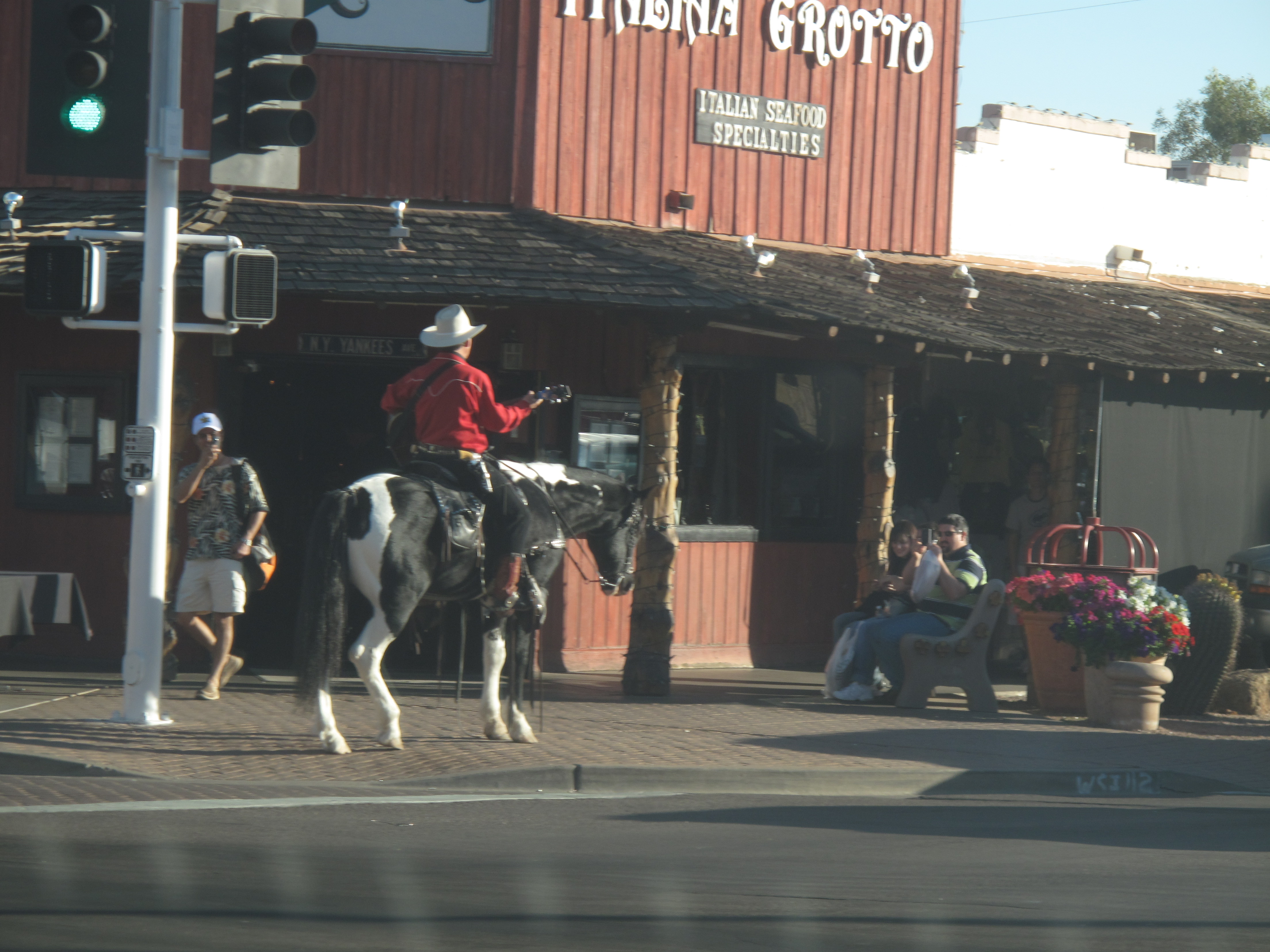
The Singing Cowboy helped, though.

The old man went on to suggest that I write his biography, but, in so many words – and no doubt never having read a word of anything I’ve written – he wanted me to tone down my weirdness and make it more accessible. The first hitch came quickly, as he recounted his side of the story of when I got kicked out of a casino for pissing in an empty parking lot and embarrassing him in front of all his fellow gamblers – conveniently forgetting the part of the story in which I watched him play poker for 14 hours straight and would have rammed my head through a wall to get out of the casino. Oh well; a modern classic fails.

I like my dad, and we had a good time in total, but it helps if there’s a slight barrier between us. As such, I’m glad I stayed at my local sister’s place, where I slept on her gigantic couch and beat back sleeplessness. And after our time was over, the old man took me to the airport, and after a few days at home in Washington, I set out again and exchanged the desert for the snow.


Y Marks the Spot: Ungainfully Employed

THE FUTURE.

There’s a billboard next to the Barnes & Noble in my new base in Washington.  Both store and sign are fairly close to my house, and as such I tend to pass them on my wanderings through town.  Each time I see the billboard, I snicker as my thoughts turn to the unrealistic possibilities of vandalism.

The sign reads “Optimism is contagious.”  Someday, I’d like to spraypaint “Get vaccinated” underneath.

The joke was in my head long before I resigned myself to the growing undercaste of the unemployed, long before my faith in my skills and talents gave way to the realities of the New Depression.  The joke has since become harder, more resentful – but it’s still a joke, and still, oddly enough, optimistic.

The story of my attempts to find a job in my new environment has a theme of sudden fuckovers following sure things.  It began even before I left Wisconsin, as I was plotting a transfer between my old bookstore and the one I now pass on a regular basis.  As an employee of long tenure and high standing, transferring should have been an easy maneuver.

Apparently it wasn’t.  I’d later find out, both personally and through quite a few other people here, that the boss of my intended new store was a pretty big dick – the type who objects to Halloween on moral grounds and uses divine intervention to justify moving to a Jesusy community.  I’m certain that this lame moral fiber played into the picture in some small way, but at the time I took the message that there was nothing available at face value.  Frankly, I didn’t mind.  I’d been doing the same work for the entire four years I’d spent back in Wisconsin, and I was looking forward to doing something else.

On the very first day of my new job hunt, I thought I had that matter taken care of.  Beyond many of its bars’ draconian policies against serving liquor, my new town’s downtown is so much better than the boozy one I left behind.  Within its array of neat shops and attractions nestled a little local record store, and as luck would have it, they were hiring as I was searching.

Being that I have years of record store experience – to say nothing of my years of music journalism – I figured that it would be a slam dunk.  In fact, following the interview, the boss and I scheduled a trial shift in which I would be given the chance to prove my mettle.  Furthermore, another employee would afterward tell me that I was only the second person he had known, in all the years he had worked there, who had been given a formal interview.  Sure thing, right?

Well, there was an issue which became a deal breaker.  As well as selling music, the record store also made its money in head shop paraphernalia, which I’m not all that familiar with.  On the morning I was to go in for my first shift, the boss called me up and called it off, stating that he really needed someone who knew the product in time for the holidays.

Reading between the lines, I’m one of the few people who can say that they didn’t get a job because they weren’t a pothead.  It was actually really funny when it happened, though less so now.

A few false starts later, I was ready to retry the bookstore transfer.  I called my old store manager and resumed the process, then called the store manager and discussed the prospects.  The Washington boss shot it down in the most dickish manner possible.  “I already have transfers coming in,” he sniped, “and you’re not them, are you?”

Nice.

The appropriateness of this exchange would come into play later when I almost got a job at a Blockbuster down the street from my house.  The store boss was a really cool guy with whom I hit it off with immediately.  Another hopeful interview came and went, with the promise of future contact implied.

Yet when I called the boss a week later to follow up, he had bad news.  Apparently a transfer had decided to ship in and take the available position, which took priority.  “We take care of our people,” he explained.  I understood, but considering my own failed attempts at transferring I saw the result as somewhat morbid.

Beyond that, there’s been a lot of trying, and even more silence.  Not even Christmas jobs have been available – though not dealing with tantrum throwing holiday shoppers and never ending Christmas music has probably saved my end of year sanity, for once.

I’ve resigned myself to the fact that this is the future.  All the fun pissant work selling books and music and movies and video games are ending due to physical products becoming electronic files.  No matter how wonderfully the economy may recover, I don’t really see the job market coming back.  My old prediction of overpopulation and technology making labor obsolete feels like it is coming true, and now we get to live with it.

And I don’t really mind.  I still don’t have it worse than at least half of the world’s population, and even if I don’t have a steady income, I have a job.  Despite a general state of cabin fever resignation, I’m pretty proud of what I do.  I get to write all these rants and reviews and interviews, and I’ve done some of my best journalism while being broke.  I’ve also used the free time on my hands to plot out some amazing stories for the future.  Since moving out here I’ve also taken up improv classes, which has blasted open a great new avenue for me to dive into.  And last week, I put on my first real stand-up performance, which I don’t mind describing as awesome.

I’ve come to the point where I have nothing in the conventional sense, yet though the situation is far from perfect I’m actually pretty happy about how things have turned out.  If this is hitting bottom, sign me up.

Y Marks the Spot: The Nasty, Brutish, and Short – On Bullying

I hate categorization, especially when it comes to human beings.  In my opinion, there isn’t much that is more of a threat to the well-being of mankind than demographics.  I see the problems created by primarily defining one’s self by gender, ancestry, age, spiritual status, and whom one sleeps with as sort of a polar paradox.  Sure, groups separate people from one another, causing bigotry, tribalism, and discrimination, but at the same time they don’t separate people far enough, to the point where every person is an individual free from all the expectations and biases of the competing cultures.

Going further, I refuse to claim a sexual orientation.  First off, I’m far too narcissistic and antisocial to define myself by the presence of someone else.  But I suppose the main reason why I choose to not define myself along sexual lines is that I demand the ability to like any person in any way that I want.  Sex holds a pretty low rank in my relationships, so describing myself as gay, straight, or bisexual would feel like a cop-out.

Of course, this means that I often get treated as though I’m gay.  Wearing makeup and dresses and singing songs about molesting the male cast of Saved by the Bell hasn’t helped.  But I think I’d get the homo label anyway.  As progressive as we like to think of ourselves, there’s still a huge gay paranoia within our society, the magnitude of which draws parallels to McCarthyism.  One must always travel with one’s identification in full view.  Among guys (and let it be noted that I’m not presuming to speak for the ladies), this pretty much means that if you’re not banging at least five smokin’ hot girls at once, in full view of the entire world, your sexuality is suspect.

As an adult, I’ve fallen victim to this meatheaded thinking, but as a teenager, in a public school, shit.  I’m going to come right out and say it: fuck public school.  It’s a refinery of anti-intellectualism populated by savage little shits constantly at war with each other.  With the exception of a few friends, teachers, and an army of guidance counselors, I hated just about every moment I spent in the system.  My great grades were no indication of my experience.  On the off chance that I have children, there is no fucking way I will subject them to what I went through.

I suppose I’m queer in the more universal sense of the word, which is to say that I’m a chronic stranger.  But in that 12 year prison term that is public education, few recognize the difference.  The weirdos are faggots, regardless of what nascent form of sexuality is developing within them, and they suffer for it.  In that hateful maelstrom of loneliness and status-seeking, I was no innocent, though I mostly survived by vanishing instead of damaging.  For the belligerent, homophobia was often a convenient excuse for being an asshole – but sometimes we were just being assholes.

I’m happier now, by the way.

So I look at the recent rash of gay teen suicides with horror and sympathy, and I think that the massive outpouring of support for these kids – especially that shown in the It Gets Better Project – is nothing short of amazing.  Comparing the current reaction to something even so recent as the Columbine shootings of 1999 is mind-blowing.  In my experience, Columbine became a justification for bullying, not against it.  All soul-searching and self-questioning were quickly drowned in reactionary concealment and witch hunts for boogeymen wearing trenchcoats.  I remember.  I was there.  I was wearing one.

Yet today I also see a danger in some of the reactions.  While most people have their hearts in the right place, I’ve picked up on a lingering tendency to emphasize the gay in gay bullying, and the gay in gay suicide.

With all due respect to the fact that homosexuality is still viewed by too many as a source for second-class citizens, and being fully aware of the monstrous shit that is still coming out of the mouths and keyboards of the wannabe righteous phobe-trolls, I don’t think that the problem of bullying should be defined by who it’s happening to.  I don’t think that most, if any, acts of brutality should be.  Suffering is personal, relative, and can’t be compared.  Between the extremes of hypochondria and institutionalized crimes against humanity, when a spectator rates one person’s misery as more important than another’s, humanity’s lesser natures tend to creep in.  It also makes people placed outside of the special circle less inclined to care.  In fighting injustice, you can’t just stand up for those you claim as your own.  You have to stand up for everybody, or nothing gets solved.

Keep in mind that the early Christians were fed to the lions.  Look how well that turned out.

So when I hear or read about people saying that people who aren’t gay can’t understand the horrors of gay bullying, my first impulse is to answer that this isn’t always true.  Just because I’m not gay doesn’t mean that I haven’t been treated like shit because someone thought I was gay.  I feel like people who make such exclusionary comments discount not only the damage and perspectives of the straights, but also those of aliens like me.

But in spite of my cynicism, I hope – to steal a phrase – that things do get better, and we take the larger view.  And I think most people are.  It may take a little nudge and a willingness for people to look beyond their usual circles, but it seems that we’re approaching a common ground where all kids will be viewed – and further, treated – as important.  That can only mean good things when those kids become adults.

Y Marks the Spot: The Selfish Gene

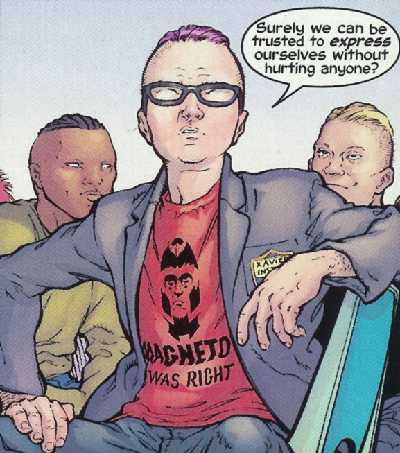
Back in 1963, a comic book guy named Charles Xavier rolled around in his wheelchair and wrote the book on “differently abled.” As what his creator Stan Lee dubbed a Mutant – a blanket label with a scope ranging from chesty telepaths to five-assed monkeys – Professor X led a crusade for equality that was unprecedented in comic book history. Lee’s intention in this landmark title was to mirror the current struggles of the Civil Rights Movement, with Xavier filling the role of Martin Luther King Jr. and his friend and nemesis Magneto playing the reactionary side of Malcolm X. Throughout its history, through its great and not-so-great story arcs, the mutants have held a unique status of being dyed in the wool heroes who don’t quite get along with those they protect. (An argument could be made for Batman being the forerunner of outcast heroes, but then again, why is he in the Justice League – and why was he played by Adam West?) As opposed to the cheers heard at the end of most Golden Age comics, the X-men are as often as not pelted with bottles and run out of town by mobs and killer robots. The obvious reason why is because they’re different, other, freaks.

This ongoing theme of bigotry and nobility in spite of it has resonated with the public, and has made the X-men one of the top comic franchises in history, and for good reason. But there has always been a problem with the series, one which has grown more obvious in recent years as storylines in the Marvel Universe have grown more Orwellian.

Let’s start at the beginning. Our pal Chuck operates his team of young superheroes within the veneer of an academy for “Gifted Youngsters.” Now, we all know what gifted means in this case; Chuck’s running a safe haven for mutants, where they can feel safe and learn to control their powers, when they’re not rising (en masse, it seems) to save the world and make it more tolerant. Much is made of Xavier’s King-like dream of peace between mutants and non-mutants.

So here’s the problem. Why doesn’t Chuck teach non-mutants? In reality, any norms who show up on campus are, here, the freaks.  You’d think that making a mutant school open to non-mutants would be a significant step toward unity and reconciliation. Nope. Instead, this school is insular and, ultimately, a defensive construct. With all the bastards trying to kill Chuckie and the Gang, walling up like this is partially justified. Nonetheless, making a school that preaches tolerance mutants-only throws the baby out with the bathwater, denies normies the opportunity to mingle with the freaks and realize that they’re not all that bad. Wasn’t integration a crucial aspect of the Civil Rights Movement? The X-men could have faced a George Wallace-like villain who stood in front of the X-Mansion, refusing to let non-mutants in. Would have been a blast.

I’ll give you a nerd catch-up on the present. In recent storylines, the mutants have suffered mass genocide at the hands of giant robots, after which the not quite dead Magneto became a Che Guevara t-shirt. His daughter went crazy, created an alternate Happyland where Magneto rules, but then all-but erased mutants, leaving less than 200 on the planet. It’s here where the X-men (who, of course, emerge unscathed) become their most insular and paranoid, dropping almost all greater altruism in favor of keeping the laser beam dodo alive. The team’s heroism becomes more narrow and embattled, focused solely upon events’ effects upon its own people. While this isn’t totally out of line, there’s more than a little persecution complex bigotry here, which ruins the original dream of peace and harmony.

This is a problem caused by the taking of sides, of tribalism, of a social Selfish Gene Theory.

The saying which comes to mind in explaining this is, appropriately enough, an Arab proverb: “Me against my brother, my brother and I against our cousin, and my brother, cousin, and I against the stranger.” As humans following (mostly invented) differences, each person finds their cultural niche, their side, which fulfills both the need to belong and the need to have enemies. The person as individual and the urge for self-preservation are obscured and replaced with delusions of serving the greater good, turning saints into monsters and martyrs.

We’re seeing this play out in Gaza, where Israel and Palestine are abusing eons of history to mandate their current savagery against each other. We’ve seen it play out in our politics, where the two-party system has created an either/or, top/down mentality. We see it in the selective acknowledgment of atrocities perpetuated throughout the globe. We see it in the absurdity of asserting that an all-loving God would have a chosen people. We see it every time someone brings any form of social category into play. A friend and I once agreed that, should the current forms of bigotry someday come to an end, humans will simply move on to hating each other based on what entertainment one consumes.

A life defined by social categories and mass-market ideals is one lacking in vitality. It’s alright to be selfish; self is critical, original, the vendor of hope. Bratty entitlement and greed are different, equally as dangerous as factioning. But each life is lived alone. In this, the only sides that matter are inside and outside. The balance between determines everything.

Y Marks the Spot: Nobody Gets Laid Until Everybody Gets Laid

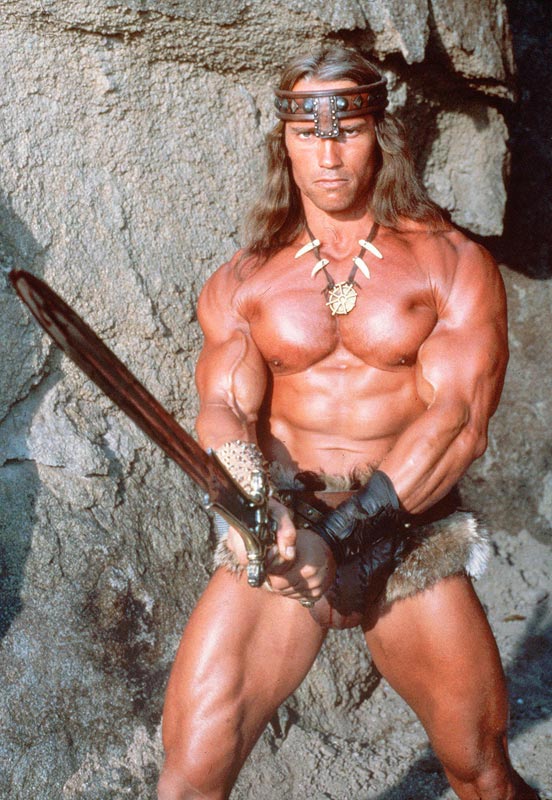
Onan the Barbarian - Moral Relativist

The line came to me during a random moment in which I wasn’t particularly thinking about anything. The thought was as follows: those people who say that homosexuality is aberrant behavior may never receive oral sex ever again.

It bothers me a great deal that even in the era of spineless political correctness and genuine good intentions, gays remain one of the most prominent divisions of humanity which – if the gay marriage battle and the transcendence of the word Faggot are any clue – it is still somewhat acceptable to discriminate against. (It bothers me more that acceptable bigotry still exists at all.) But this doesn’t really have much to do with my original point. Denying junklicking to those put off by the gay lifestyle, in this case, is neither a defense of homosexuality nor the usual hate-the-hater schtick that we get a lot of these days. What it has to do with is logic. More importantly, it has to do with the malleability of morality.

Many critics of same-sex relationships take some sort of justification from religious dictates: man must not lie with man, ape must not kill ape, whatever. But here’s a little biblical tale that the right to lifers like to bring out from time to time, one which comes to bite any Junior Inquisitor in the ass when it comes to sexual deviancy from the party line. It’s our old friend, the Sin of Onan!

Onan wasn’t exactly a pervert. He was just a guy who didn’t want to knock up the wife of his dead brother (whom God had already killed). But family obligation raised its ugly head, so while Onan and his sister-in-law were in the throes of family obligation, he decided to spill his seed on the ground – to waste it, in essence, instead of flooding the earth with more obedient little monkeys. And God smote the bejezus out of him.

Now how many of us – heterosexual, homosexual, or one-man band – are guilty as hell of this?

Though action against nonprocreation and other sexual aberrations has always been a highly biased affair, and gays are a historically easy target in this, there have been edicts and laws that have condemned ANY sex act outside of the missionary position – to say nothing of the Ten Commandments’ bleak outlook on adultery. Sodomy now refers to a fairly specific act, but at one point it included pretty much anything that wasn’t P vs. V. And sodomy laws could get pretty severe, going so far as to prescribe castration or Payne of Deathe upon the transgressors.

They’d love our society. Take a look on the internet. Browse a sex shop. Read the Kama Sutra or any of its thousands of descendents. Watch a soap opera. Even the most tame bit of sexy business in our modern public forums would probably have gotten a person executed centuries ago at the hands of people a lot more pious than today’s opponents of gay marriage. And we are positively rendered impotent by sexy business.

Then again, there are still places on present-tense Planet Earth where a woman can get stoned for being raped. There are places where men sleeping together is an unpardonable sin, whereas women sleeping together is a minor threat to society (which once more reinforces the bullshit idea that lesbians always teeter one dude away from a triumphant three-way). And that great bastion of opulent morality, the condom-condemning Catholic Church, is still trying to dodge responsibility for the wholesale sexual abuse of children – oh, and they’re also tacitly endorsing the spread of AIDS by casting condoms to the tire fires of Hell.

What this says to me is that morality is a game that rarely plays in absolutes, if at all. Like history, it’s written by the winners. So people can lean on all the archaic moral precedents in the world, but what’s really happening is that they are contorting ethical revelation to suit their personalities and prejudices, not the other way around. In small doses and absent of entitlement or repression, this isn’t always a bad thing. Cherry-picking can free us from dogma that is no longer relevant. But at the same time, perhaps we could take better responsibility for what creeps us out. I have a greater respect for a person who says that he or she has problems with gay marriage, abortion, or porn stars (that one’s actually mine), than someone who passes the buck on to God and tries to prance around, blameless and hatefully obedient. Own your beliefs; it makes it easier to evolve them, even if you’re a creationist.

Morality will continue to change, and all of us will continue to break the rules. But for our ethics to have merit beyond stone throwing in glass houses, nobody gets laid until everybody gets laid. If only metaphorically.