Bizarro Masterpiece Theatre: The Apple

The Apple: One of the strangest films, ever.

Movie: The Apple (1980)

Directed By: Menahem Golan

Starring: Catherine Mary Stewart, Allan Love, Joss Ackland

Written By: Menahem Golan

Sweet tapdancing Christ. My fellow B-movie cohorts, Mr. Heinrich Maneuver and Miss Luna, dropped a fucking bomb on me this week. When you’re offered a biblical disco musical about a Village People-fueled dystopia, you run with it. While this movie is firmly lodged in the Rocky Horror tradition, The Apple is a more kinetic, possibly creepier, certainly more bedazzled upgrade.

This is a tale of two Canadian kids who come to the big city in order to ply their pansy ass Carpenters act against the tide of Nero-sized disco. The evil BIM corporation, ruled by the sassy yet diabolical Mr. Boogalow, (yeah, I know,) is not amused. Flanked by his cadre of black drag queens and fluffy-haired Roger Daltrey impersonators, Boogalow puts on his best Klaus Nomi tuxedo and sets to work absorbing the heroic Alphie and Bibi into his infernal system. Following a hellish ripoff of “The Time Warp,” Bibi succumbs to the BIM allure. Alphie, however, runs away like a little girl, and spends a good 15 minutes mooning around in a nice Jewish woman’s New York tenement (and serenading her, and groping her sweet rack). Nobody in the biz wants to listen to his wussy tunes, and the law is cracking down on him for not wearing his BIM mark of the beast. What’s a sad panda to do, but storm back into BIM Central, sleep with one of the disco ladies, and then bust through a pane of glass, lit up in green lights and looking like a crybaby Incredible Hulk? Magnificent!

The best parts of this movie are the BIM anthem in the beginning, and the ending. And though the opening song is one big bowl of tossed ass-kick salad, the conclusion to this masterpiece may have the posterity of being one of the worst (and most glorious) endings of all time. In literature and theater, the term deus ex machina (“God from the machine”) refers to a sudden ending that defies the logic of the rest of the story. South Park’s Crab People would be an example. In this movie, deus ex machina can be taken literally, down to the flying car. What happens is one of the most baffling finishes to a film that I have ever seen, made only slightly tolerable by the most evil dude from Bill and Ted’s Bogus Journey playing God.

Wow. This film is friggin’ amazing.

Bizarro Masterpiece Theatre: Balls of Fury

Walken, Causing Trouble Again

Movie: Balls of Fury (2007)

Director: Robert Ben Garant

Starring: Dan Fogler, Christopher Walken, James Hong

Written by: Robert Ben Garant, Thomas Lennon

You might think that Christopher Walken would be the show-stealer in this tale of ping-pong glory. You’d be wrong. As a Fu Manchu wannabe gangster, Walken certainly tears up any scene he appears in. The absurdity of seeing him dressed in all manner of formal Chinese attire is as hilarious as it is weird. Yet there are three characters in Balls of Fury who upstage him.

The first is a jacked-up German with a perfect blond flat-top and spandex battle gear who serves as the hero’s ping-pong nemesis. Played by Thomas Lennon (Reno 911’s Lieutenant Dangle), Karl Wolfschtagg storms through the film, ready to throw down on anyone in his way. Lennon’s wide-eyed intensity is kind of awesome.

The second is Diedrich Bader, who portrays a tank-topped concubine in Walken’s man-harem. Sent to the hero’s bedchambers, he has to spend the night or die. Undeterred, the hero and the man-whore have a rockin’ night playing Boggle and hanging out. Bader plays his character with a delightfully dimwitted optimism that I’m sure is absent from most male prostitutes.

Yet the best performance in Balls of Fury is that of James Hong, who once more serves admirably as the token dirty old Asian. Best known for his role as the crazy old wizard Lo Pan of Big Trouble in Little China, Hong turned “Indeed!” into a cult classic password. Hong’s role in Balls of Fury mixes Lo Pan’s fixation on honor with the more earthly creepiness of his role in Revenge of the Nerds II and his ambiguously gay persona in Totally Awesome! As Walken’ blind former mentor, Hong reluctantly takes on his round-eye protégé to obtain satisfaction. He plays this role with such an imperious witlessness that he is a joy to watch.

Considering all this, the fun in Balls of Fury becomes less about the story itself and instead in watching the crackpot characters which populate it. Indeed, the main characters are often less compelling than the supporting cast. As hero Randy Daytona, Dan Fogler – who seems to be getting typecast as a Belushi-via-Jack Black – pretty much autopilots on the wildman schtick he improved upon as a Star Wars geek in Fanboys. In total, he’s more fun than George Lopez’s FBI straight man, but Lopez commits an act of desperation in the film which boosts his character past the hero.

The concept of Balls of Fury is ludicrous, but that works in its favor. You might think that an epic comedy about ping-pong wouldn’t work out. You’d be wrong.

Bizarro Masterpiece Theatre: Wesley Willis’s Joyrides

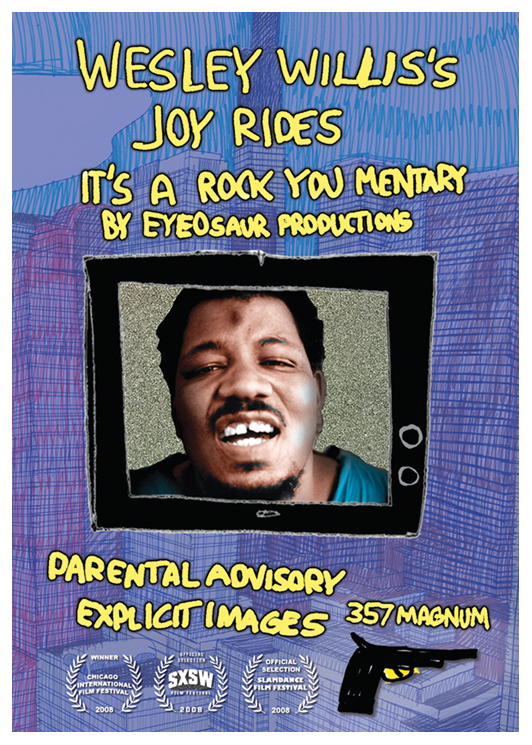
Wesley Willis's Joy Rides

Movie: Wesley Willis’s Joyrides (2009)

Directed by: Chris Bagley and Kim Shively

Starring: Wesley Willis

I’ve been waiting for this movie for a long time. Shortly after rock and roll hero Wesley Willis died of leukemia in 2003, and not long after the first documentary to focus on the schizophrenic musician, The Daddy of Rock ‘n’ Roll, came out, rumors of another documentary began circulating. A few clips were posted on the internet, but for years nothing more was said about the film. Well, Wesley Willis’s Joyrides is finally out, and as expected, it put a big smile on my face.

As opposed to the first film’s more day-in-the-life perspective of Wesley Willis, Joyrides takes a larger view of the man. The film rides a slow path through his troubled upbringing and his life drawing the streets and buildings of Chicago before arriving at his music career. In fact, it’s Wesley’s art and not his music which provides the neatest aspect of this story, as the creators of Joyrides animated some of his drawings. The effect is just magnificent.

Many people come out of the woodwork to paint Wesley’s story. Many of these folks are close friends and supporters from the Chicago art and music scenes: bandmates, fellow artists, and people who looked after him when no one else would. Yet the telling of Wesley’s youth and many of the terrible things that happened to him falls largely to members of his family. The time the Willis family spends onscreen ranges from informative to disturbing. Two of his brothers are among the film’s best sources in explaining why Wesley Willis was the way he was. On the other hand, Wesley’s father appears to be cashing in on his son’s fame in order for some screen time. The man is described as a horribly neglectful father, which he in so many words dismisses by stating that he “didn’t realize how great that boy was” until everybody else did. Nice.

To be sure, there’s a lot of exploitation and neglect in Wesley Willis’ life. Yet in spite of the many upsetting aspects of his life, directors Chris Bagley and Kim Shively ultimately keep their focus on what made Wesley so endearing and loveable to so many people. Wesley’s freakouts aren’t hushed up, but his humor and delight are far more pronounced, qualities which overwhelm everyone he meets. Even while facing death, Willis keeps his spirits high, singing a song praising his cancer doctor and playing his old classic “The Vultures Ate My Dead Ass Up.”

The film of Wesley’s life is every bit as contagious as the man himself. It’s a hard and lonely road between the joyrides, but Wesley Willis’s Joyrides is exactly what it claims to be.

Bizarro Masterpiece Theatre: Liquid Sky

Anne Carlisle, and Anne Carlisle

Movie: Liquid Sky (1982)

Directed by: Slava Tsukerman

Starring: Anne Carlisle, Otto von Wernherr

Written by: Slava Tsukerman, Anne Carlisle, Nina V. Kerova

I may have found my crapseeking limit. I’m not sure what Liquid Sky meant to accomplish with its sordid tale of drugged-out hipsters and opiate aliens, but it’s certainly one of the dumbest, most crackheaded films I’ve ever seen.

The story focuses on Margaret (Carlisle), a Bowie-wannabe model who ingests drugs, lurches around, and gets raped with equal frequency. Her immediate circle consists of a mongoloid-looking drug dealing girlfriend, an old hippie lover, and a slick, sneering, pretty boy enemy named Jimmy. (He’s also played, wonderfully badly, by Carlisle, who in this guise sounds like a 15 year old boy trying to buy beer.) Beyond the hippie, none of these people are what you’d describe as rational. Indeed, almost nobody in this film is. All the characters either jitter around like epileptics or strike morose poses and come off as pretentious assholes. There’s no in-between.

After a U.F.O. the size of a dinner plate lands on the roof of Margaret’s apartment, the alien within watches her make a fool of herself. That evening, the Mongoloid (who is the worst element of the film) gives a horrible musical performance where she raps about her “rhythm box.” Then the cool kids put on a vapid fashion show, and Margaret gets raped by an Andrew McCarthy doppelganger. Following the degradation, the alien makes poor Margaret its champion and sets her loose to kill villains through orgasm, which somehow turns their brains into crystals. Whatever.

The production in this movie is ridiculous. Awkward editing and jarring jumps to solarized negative weaken the film on the visual end, but what’s worse is that Liquid Sky may boast the worst score of any film, ever. It’s as though the director injected a monkey with heroin and forced it to play a synthesizer.

Still, I will give the film a few positive points. Occasionally, Margaret becomes eerily interesting, and the knife fight she gets into with the Mongoloid (over the hippie’s dead, naked body) is pretty swell. And I’m always a fan of dumb Deus ex Machina, which this film delivers in U.F.O. form. Yet the very best thing about this film is the giant German astrophysicist and his sweet wavy 70s hair, high-ridin’ pants, and red leather jacket. Coming to America to stop the alien, he fights off Jimmy’s horned-up mom in his quest for intergalactic justice. And it’s damn hard to fight off a line like “you have a laser gun in your pants?” What a champ!

Yet our Teutonic hero can’t save Liquid Sky. It’s so vacant, so hopelessly fashionable, that I wouldn’t be surprised if Lady Gaga soon starred in a remake.

Bizarro Masterpiece Theatre: World’s Greatest Dad

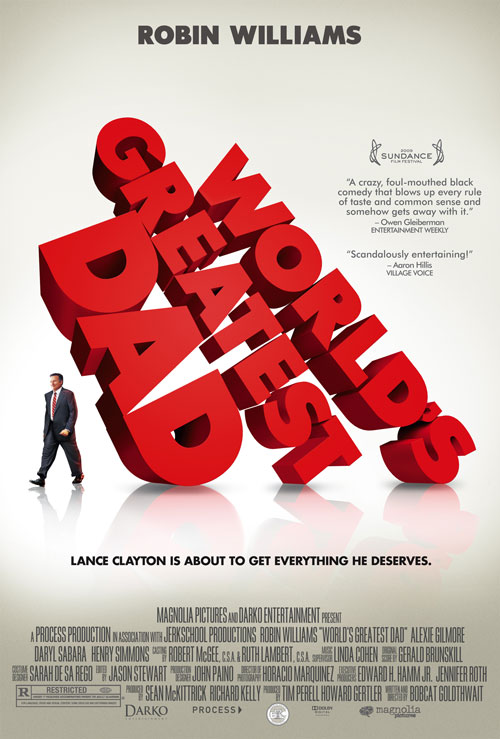
World's Greatest Dad

Movie: World’s Greatest Dad (2009)

Director: Bobcat Goldthwait

Starring: Robin Williams, Alexie Gilmore, Daryl Sabara

Written by: Bobcat Goldthwait


So I recently found out that my cousin, the one closest in age to me, just died. My reaction to the news, to put it mildly, was not filled with sadness. I’ll avoid going into excessive detail about my non-relationship with my dirtbag relative and instead let the last time we spoke speak volumes about the whole. It happened during the first night I came back to visit La Crosse after moving away in California, what I’ve referred to in the past as my “This Is Your Life” night. My cousin and I were both trashed and stumbling around downtown when we came across each other, and after the usual reunion faux-enthusiasm things went sour. First he offered me cocaine. Then he started to bitch about how I hadn’t let him know I would be back in town (I didn’t have, nor would I have used, his contact information). To top it off, he flipped out on a good friend of mine who tried to bail me out of the uncomfortable situation. My cousin took off his shirt and puffed up his chest before throwing what I’m assuming was meant to be a pulled punch, but one which faintly connected anyway. Having very little cognitive ability left, I watched the disaster play out with wide, blank eyes before escaping. When I reflected on it later, I decided that if I never saw my cousin again, I’d be perfectly happy.

I didn’t. And I am. But I wonder how his dirty life will be whitewashed in death, how many of his sins and exploitations will be forgotten, and how much of who he really was will be left in the memories of anyone who cares to remember him.

The Asshole Martyr

It’s further testament to my total apathy about all this that I didn’t immediately find parallels between what just happened and a film I watched days later which brilliantly confronts the phony veneration of the dead. The martyr of World’s Greatest Dad is a high school douchebag named Kyle (a disgustingly swell performance by Daryl Sabara), who snuffed it while choking himself and jerking off. In life, Kyle was a pervy prick who treated everyone around him like shit. As a result, his entire social circle consisted of one (very browbeaten) friend and a father whose only affection for him came from the bondage of family. In death, Kyle became a saint, a genius, the school mascot. He could do no wrong; the very people who hated him before he died were scrambling for any scrap of him afterwards, some going so far as to fight over a not-exactly-teen-fashionable Bruce Hornsby album because they thought it was Kyle’s favorite. (In truth, as typical, Kyle hated everything.)

This outpouring of doctored memories and false grief is his old man’s fault. Robin Williams turns in a tremendous performance as Lance Clayton, a frustrated writer and poetry teacher who stupendously fails at turning his son’s death into something positive. As maligned as anyone else was by Kyle, Lance nonetheless cries his eyes out upon discovering his son’s body. Williams’ restraint and abandonment in this scene creates the film’s most heartbreakingand stoic moment.

Finding the Body

Attempting to cover up the nature of his son’s death, he hides the hand lotion and porn and hangs his son in the closet door. Dad then pulls out his writing talents and pens a poignant suicide note, which he tucks into dangling Kyle’s pocket. The community – which has apparently never seen an episode of CSI – buys the cover story, but the scheme works a little too well. Lance’s gesture of dignity soon devolves into a mire of exploitation in which the father is both swept along by the contrived grief of others and using his son’s memory for his own ends. The greatest evidence of Lance’s complicity in the affair is in his writing of a fake journal which he passes off as his son’s. With the help of the school’s grief counselor – a more blatantly conniving and desperate bastard – Lance gets all the fame he ever wanted before realizing that he’d rather not hang himself by the charade anymore. In the film’s final moments, Williams delivers a joyously deadpan fuck-you-all moment, calling his son out for who he really was and giving up the game. And after that, there’s some Robin Williams dong.

Say what you will about Bobcat Goldthwait’s spastic acting career, but as a director and screenwriter he’s terrific. The hero worship of the dead presented in World’s Greatest Dad might have come off as a tad implausible before the death of Michael Jackson, but in a world where everyone can turn on a dime, calling someone a freak in one breath and a genius in the post-mortem next, this premise is downright sensible. Goldthwait has created a very dark comedy, but what’s most notable about this film is how it’s also a very deep, realistic, and compassionate breed. There’s no slapstick or cheap punchlines; instead Goldthwait presents fleshed-out characters who act out what is, at the core, a story about a man freeing himself from the expectations of others – even if someone had to die for him to do it. It’s not always an uncalled for type of liberation.

Bizarro Masterpiece Theatre: Uwe Boll Double Feature

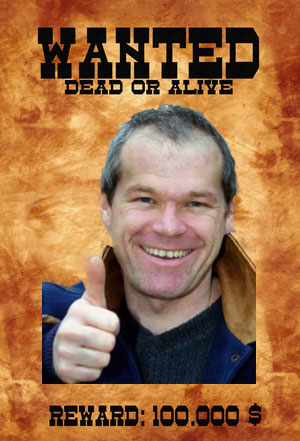
Uwe Boll: World's Most Hated Director

The Oh My God, These Uwe Boll Movies Don’t Suck! Double Feature

Over the years Uwe Boll has amassed a legion of despisers who hold that he is the worst film director of all time. As the director of such cinematic bombs as House of the Dead, BloodRayne, and Alone in the Dark, he is so hated in some circles that at least one petition has been circulated calling for his retirement, one of which amassed thousands upon thousands of signatures. One notable event to come from the Uwe Boll hatefest saw the director boxing five of his harshest critics, beating them all to a pulp. Obviously he’s not loved.

Boll has been referred to as the German Ed Wood, yet having slogged through the monumentally atrocious House of the Dead I feel that comparison does the Emperor of Bizarro a grave disservice. Yet beyond House I’ve avoided Boll’s curriculum vitae like the plague, so my knowledge of his work is essentially that everyone else says he sucks – and who knows how far that hearsay goes. On one point, at least, I’m willing to give Boll the benefit of the doubt and write off his bad reputation on the fact that he’s made little beyond video game movies for the past few decades. There has never been a great video game movie, and Uwe Boll is probably not the man to make the first.

Still, I’m sure I’m not alone when I assumed that Uwe Boll’s recent foray into more serious filmmaking would turn out to be a sick joke which would fail magnificently. Yet I was stunned – stunned! – to discover two Uwe Boll films which were actually quite good. For a director who has engendered such low expectations, such backhanded praise is akin to nominating him for an Academy Award.

Both Stoic and Rampage take long, uncomfortable views of angry young men who leap (and are not pushed, a vital distinction) into terrible acts of violence. Neither allows its disturbing savagery to become gratuitous or exploitative. Of the two, Stoic is the superior film, whereas Rampage is more visceral.

Stoic’s story involves a real case in the German prison system in which three inmates tortured a fellow prisoner to death. Well, the official story is that the prisoner committed suicide, but the film’s stance is unambiguous about it being a murder. None of the three torturers are innocent – each committing horrible acts upon their victim – but what this movie becomes is a question of degrees, of who is most guilty and most evil. Interviews conducted after the murder show the three inmates fluctuating between states of remorse and nonchalance, each trying to wriggle his way out of blame. It’s hard to tell who is really on the level, but the skinny guy who gets saddled with the lion’s share of blame comes off as remorseful and (comparatively) sympathetic. In contrast, the cell’s big German skinhead and tubby Edward Furlong soon emerge as the callous monsters, and each gets away with reduced punishment. Yes, Edward Furlong is in this film, and he’s as whiny and nasal as ever, but he also turns in a sinister and conniving performance that is easily his best work since American History X.

One idea advanced at film’s end is that not every criminal deserves to be tossed into prison with the rest of the dogs. Furlong’s scumbag and the German hulk were in prison for violent crimes, but skinny boy got busted for drug dealing while the dead kid’s crimes were vagrancy and resisting arrest. Throwing violent and nonviolent offenders in the same environment, Boll asserts, is a miscarriage of justice.

Rampage affords no such moral ambiguity; it is a straight-out spree killer film. The machine-gunning marauder who serves as this film’s focus spouts out high-minded screeds about overpopulation and anticapitalism (parroting his friend’s more sincere beliefs), but when he puts on his body armor and starts the slaughter, the gunner makes sure to hunt down those who wronged him earlier, and he runs off with a wad of cash. The result is nothing more than an act of revenge terrorism.

There are a few aspects of this film which annoy the hell out of me, facets which flicker through the scenes leading up to the carnage. Boll repeats the same monologues and soundbites over and over in an attempt to show the insanity of the world, a move which instead drags the movie and is really irritating. A smaller complaint is the beginning shows second-long bursts of the killing to come. I know that the film is called Rampage, and it’s not as though the viewer doesn’t know what to expect, but I’d like the action to happen in its own time.

Nonetheless, the rampage itself is gripping and surprisingly restrained. The motivations and acts of the killer are unsettling in their realism. However, there is one part of the movie which falls to surreal humor and doesn’t fit with the rest of the film. The killer, armed and in full body armor, wanders into a bingo hall, where the old folks are too engrossed in the game to notice him. Disgusted, he leaves without firing a shot, noting that they don’t need his help to be dead. It’s a weird moment of levity that, at least, is funny.

Uwe Boll, you’ve done well! Hey, maybe I’ll review BloodRayne 3 when it comes out! Okay, maybe not.